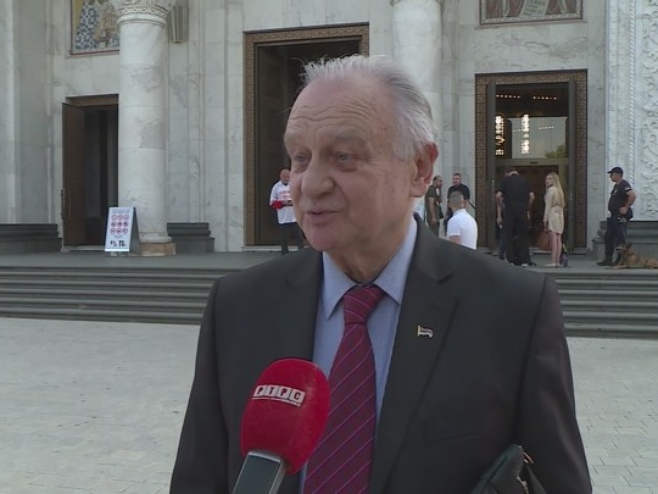

Acting Director of the Memorial Center for Serb Victims of Podrinje and Birač, Branimir Kojić, said that the flow of money and the way the Potočari Memorial Center operates need to be investigated, arguing that Serbian institutions and memorial sites do not enjoy even remotely comparable financial and institutional conditions.
Speaking about the ongoing financial investigations concerning the Potočari Memorial Center, Kojić said that significant funds flow into the institution from various sources, while institutions preserving the memory of Serbian victims struggle with a lack of funding.
“Emir Suljagić, director of the Potočari Memorial Center, receives enormous amounts of funding. BiH institutions provide them with full funding from the budget. I watched Suljagić yesterday saying that this means nothing to them and that they receive much more money through donations,” Kojić said.
According to him, the Potočari Memorial Center enjoys support from international donors, while Serbian associations struggle to secure funding for their activities.
“We know that every one of their projects is financed by someone else, while on the other hand we are pleading for some of those international ambassadors or politicians to come and pay tribute to our victims,” Kojić said.
He noted that this year, for the first time, a representative of US President Donald Trump’s administration responsible for religious affairs participated in such an event, while commemorations of Serbian victims are generally attended by domestic officials and the Russian ambassador.
Kojić also pointed to what he described as differing attitudes among parts of the international community toward Serbian and Bosniak victims, arguing that information about Serbian suffering is often presented differently by the media.
“When the media come ahead of July 11 and 12 and speak with us, they completely turn the story and its context around. They take what we tell them and turn it in another direction, seeking to portray us as criminals and further demonize us,” Kojić said.
He added that such experiences have made representatives of Serbian institutions and associations more cautious when communicating with the media and that they seek guarantees that their statements will be presented in full.
Speaking about international officials visiting Srebrenica, Kojić cited the example of a former Swedish ambassador who, according to him, wanted to speak with representatives of the Serbian community as well.
He claimed there had been an occasion when the ambassador was told that she could not visit certain locations if she subsequently planned to meet then-Srebrenica mayor Mladen Grujičić.
“We ask every ambassador who wants to see the truth and learn about our suffering to come. We will pay for your lunch and welcome you as our guests. We do not need anything, do not bring us anything. We only ask that the truth finally see the light of day,” Kojić said.
He compared the position of the Memorial Center for Serb Victims of Podrinje and Birač with that of the Potočari Memorial Center, saying that the work of the Serbian institution is largely based on volunteer engagement.
“I do this job voluntarily as acting director. I receive no salary. Suljagić, meanwhile, has security and an official vehicle,” Kojić said.
He particularly highlighted the number of employees at the Potočari Memorial Center, claiming that, according to his information, it employs 197 people, while his organization does not have sufficient funds to pay even one employee.
“I had one woman working in the organization and we do not have the money to pay her salary. They have 197 employees. Suljagić boasts that all the young people from Srebrenica work at the Memorial Center. Where does that money come from?” Kojić asked.
Kojić said he believes financial issues related to the Memorial Center’s operations must be thoroughly investigated, stressing that the problem is not the fact that money is being provided, but that its expenditure must be transparent and in accordance with the law.
“There is no problem with money coming in, but pay your taxes and contributions, as everyone normally has to,” Kojić said.
He also claimed that, in addition to preserving the memory of victims, the Potočari Memorial Center exercises significant political influence and that messages directed against Republika Srpska and its leadership originate from the institution.
“Seven or eight years ago, I said that Potočari was a testing ground in the hands of embassies. Many laughed at me, but now we can see attacks being launched against Republika Srpska, its leadership and everyone else,” Kojić said.
As an example of the attitude toward Republika Srpska institutions, he cited an incident several years ago when, according to him, a Republika Srpska government delegation was prevented from entering the Potočari Memorial Center.
“I believe allegations of possible misuse of funds need to be investigated, but the final answers should come from the competent institutions. If they truly want truth and justice, then anyone who engaged in financial misconduct should be held accountable. Take responsibility,” Kojić said.
He said police and prosecutors should be involved in the investigation in order to fully establish the facts.
Kojić also highlighted what he considers a longstanding problem of insufficient international visibility of Serbian victims. He recalled that a large number of Serbs, including civilians, women and children, were killed in the Podrinje region during the war and argued that these victims receive significantly less attention in international media.
“The image of the war in the 1990s that exists in the international public today is distorted, to say the least, precisely because it was almost impossible to reach Western media with the facts that more than 3,000 Serbs were killed in Podrinje well before 1995,” Kojić said.
He stressed that the Serbian side must invest more in researching, documenting and internationally presenting facts about the suffering of the Serbian people.
“They won the media war, but now we have to fight. If we do not fight, history will be rewritten,” Kojić warned.
He praised the work of the Republika Srpska Center for Research of War, War Crimes and Missing Persons, saying that the institution makes a significant contribution to documenting wartime suffering.
Kojić emphasized the importance of presenting Serbian victims to the international public, noting that representatives of Republika Srpska institutions and organizations have spoken at the United Nations on several occasions about the suffering of Serbian children in Podrinje.
He concluded that financial investigations concerning the Potočari Memorial Center should be carried through to the end, regardless of who might be subject to scrutiny.
“Everyone should get involved. Let us get to the bottom of this and see what is happening and what the real truth is. Everyone must learn the truth. Any potential misuse of public money should not be viewed through the prism of ethnicity, because citizens of all peoples have the right to know how funds from public budgets are being spent,” Kojić said.
Source: RTRS