


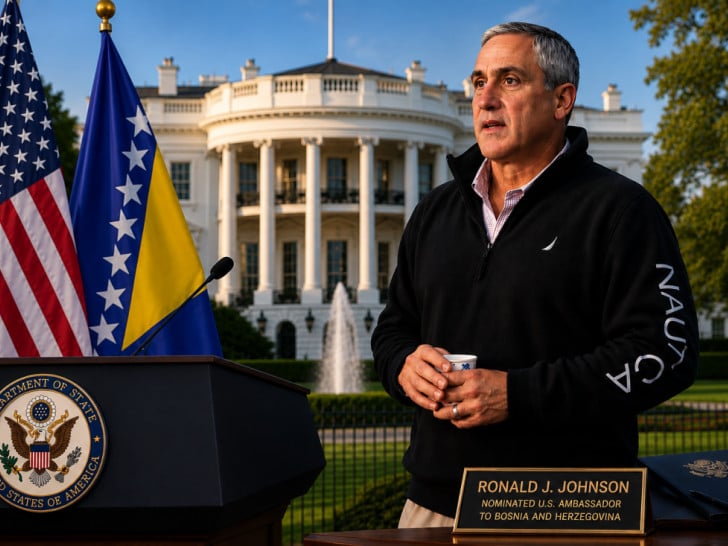
The United States could soon send to Sarajevo an ambassador with a markedly different profile from those Bosnia and Herzegovina has traditionally seen. Instead of a career diplomat, Washington has nominated retired US Marine Corps Brigadier General Ronald Johnson, a figure with decades of military, command and international security experience.
A request for agrément has already been sent to the institutions of Bosnia and Herzegovina, marking an important step toward his arrival in Sarajevo.
The Presidency of Bosnia and Herzegovina has now granted agrément to Johnson as the next US ambassador to BiH. Agrément represents the host country’s diplomatic consent to the appointment of a head of mission. The positive response clears the way for the next stage, although Johnson must still complete the confirmation procedure in the US Senate before formally taking up the post.
What Washington wants
The White House submitted Johnson’s nomination to the Senate together with that of Michael K. Young, who has been proposed as the next US ambassador to Serbia.
At first glance, these may appear to be routine personnel changes. However, the choice of candidates with such different backgrounds is difficult to separate from the broader approach of President Donald Trump’s administration toward Europe, NATO and the Balkans.
This raises the question of what Washington now wants from Bosnia and Herzegovina and what role Republika Srpska could have within the new US approach to the region.
Johnson spent more than 30 years in the US Marine Corps. He served as a United Nations military observer in the Middle East, participated in Operations Desert Shield and Desert Storm during the Gulf War, served at Guantanamo Bay and took part in Operation Iraqi Freedom.
He commanded Marine units, worked on security issues in Central Asia and was involved in the evacuation of US citizens from Beirut. After retiring from the military, he continued working on strategic and security issues.
This is not the profile of a conventional diplomat. Johnson would arrive in Sarajevo with a professional background shaped primarily by defence, security and crisis management.
That makes it reasonable to expect stability and security in Bosnia and Herzegovina to occupy a significant place in his mandate.
It does not necessarily mean a return to a more interventionist US policy or any form of military administration. It does, however, suggest that the security dimension of Bosnia and Herzegovina remains important to Washington.
The future of the OHR
At the same time, the Trump administration has increasingly signalled a different approach to US engagement in Europe and the Balkans.
Its emphasis has shifted toward clearly defined American interests, security, economic benefits and tangible results, with less focus on political engineering and more attention to managing risks and strategic interests.
Political analyst Nebojša Malić sees the nominations of Johnson, Young and other candidates as a possible indication of this changing approach.
In his view, Washington is becoming less interested in reshaping societies and political systems and more focused on the concrete benefits that can be achieved through economic, military and strategic cooperation with local authorities.
“The era of imperial proconsuls is over,” Malić said, arguing that it is unlikely the new US ambassadors will resemble some previous representatives who exercised significant influence over domestic political processes.
According to Malić, much will depend on whether the new ambassadors strictly implement White House policy or attempt to develop their own political approach toward the region.
Within that context, the future of the Office of the High Representative gains additional importance.
In recent months, Washington has sent signals that the role of the international representative in Bosnia and Herzegovina could become more limited and that domestic institutions should assume greater responsibility for resolving internal political disputes.
This does not automatically mean that the United States is abandoning the OHR, but it does open the possibility of a shift away from strong international supervision toward greater reliance on domestic political agreements.
For Republika Srpska, such a development would be particularly significant.
A more limited role for the High Representative would not in itself mean a change in US positions on every major issue in Bosnia and Herzegovina, but it could reduce the scope for direct international intervention in domestic political processes.
If Washington were also to place greater emphasis on direct dialogue with all domestic political actors, including Banja Luka, that would represent a noticeable departure from periods when US diplomacy and the OHR were often perceived as acting within the same political framework.
Johnson’s appointment could therefore become an important test.
Sending a general to Sarajevo does not necessarily mean greater US interventionism. It could instead indicate a different form of engagement, with less political tutelage and greater focus on security, stability and clearly defined American interests.
Strategic partnership with Serbia
Johnson’s nomination takes on additional significance when viewed alongside Washington’s choice for Serbia.
While a retired brigadier general with extensive military and international security experience has been nominated for Sarajevo, Washington has proposed lawyer and experienced diplomat Michael K. Young as ambassador to Belgrade.
Young has held senior positions in the US State Department, participated in major international negotiations and worked on international law, trade and foreign policy.
“Washington is sending a general to Sarajevo and a diplomat to Belgrade,” Malić said.
He noted that the difference in professional profiles does not prove that the United States has two entirely separate policies for the region, but it may indicate different priorities.
Diplomat Zoran Milivojević believes the appointments to Belgrade and Sarajevo should be viewed as part of a broader reassessment of US policy toward the Western Balkans.
He pointed in particular to the memorandum on strategic cooperation between the United States and Serbia, signed by US Secretary of State Marco Rubio and Serbian Foreign Minister Marko Đurić.
According to Milivojević, the document demonstrates an effort by Washington and Belgrade to raise their relationship to a broader strategic level, with greater room for economic, energy and security cooperation.
He argues that this development suggests Washington increasingly views Serbia as an important regional, strategic and economic partner rather than primarily through the issues that have traditionally dominated US policy toward the Balkans.
At the same time, Johnson’s nomination for Sarajevo indicates that the United States continues to view Bosnia and Herzegovina largely through the prism of stability and security.
This, Milivojević argues, may be the central message behind Washington’s latest personnel choices.
The United States is not using the same instrument across the entire Balkans, but neither does it intend to withdraw from the region.
In Belgrade, the focus appears to be on diplomacy, law and economics. In Sarajevo, the emphasis appears to be on security and stability.
Between the two stands Washington’s broader effort to preserve its political, economic and security influence across the region while using different priorities and tools in different capitals.
Montenegro
Washington has also recently nominated Peter McCoy of South Carolina as the next US ambassador to Montenegro.
McCoy is a lawyer and Republican who served as US Attorney for South Carolina from 2020 to 2021 after being appointed by then-President Donald Trump.
Before that, he served as a member of the South Carolina House of Representatives.
Source: Glas Srpske