
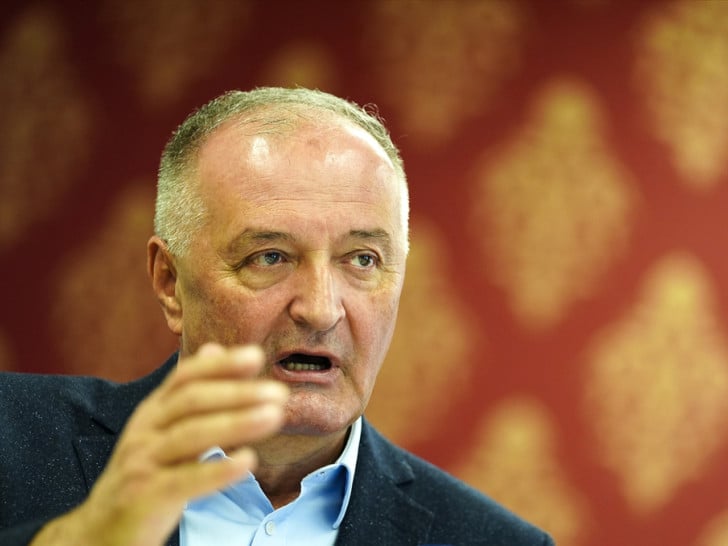
From the “Sarajevo Safari” allegations and claims about alleged military camps to his latest accusations regarding the security detail of Serbian President Aleksandar Vučić, Bosnia and Herzegovina’s Defense Minister Zukan Helez has, for years, built his political profile on reviving wartime themes and making serious accusations against Serbia and Republika Srpska.
This is the assessment of political analysts and security experts, who warn that such rhetoric does more to revive past conflicts than to address genuine security challenges. They argue that making serious allegations without a clear institutional outcome does not contribute to stability but instead deepens distrust among political actors in Bosnia and Herzegovina and across the region.
According to these analysts, Helez’s public appearances in recent years have consistently focused on harsh rhetoric directed at Serbia and Republika Srpska, with issues related to security, the legacy of war, and relations between Belgrade and Sarajevo repeatedly taking center stage.
Latest controversy
The latest dispute arose during Serbian President Aleksandar Vučić’s visit to Republika Srpska and the Federation of Bosnia and Herzegovina. Helez claimed that the police of the Central Bosnia Canton had responded to alleged violations of security procedures during Vučić’s visit to Bugojno, adding that “Vučić has learned that the Drina is indeed a border.”
Vučić rejected those claims, calling them false and stating that none of the personnel in his security convoy came from Serbian security services. According to him, the security detail consisted exclusively of members of the Special Anti-Terrorist Unit of the Republika Srpska Ministry of Interior.
“Do you realize what a lie that is? There was not a single person from Serbia. The men on the quad bikes were members of the Republika Srpska Ministry of Interior. Everything he said was false. It seems he was upset that I came to my native Bugojno and my homeland without asking his permission. I will never ask anyone for permission to visit my own birthplace,” Vučić said.
Security expert Slobodan Župljanin argued that Helez continues pursuing the same political narrative because he is unable to deliver concrete results for Bosnia and Herzegovina.
“The only thing he can do is make sensational public statements that appeal to a narrow circle of supporters. Everything he has claimed—from drones and the ‘Sarajevo Safari’ to alleged military camps and similar stories—has ultimately collapsed,” Župljanin told Glas Srpske.
Political interests
Instead of addressing who was responsible for and what became of the investigation into the attempted attack on Vučić during his visit to Potočari, Župljanin said Helez continues to act primarily in line with his party’s political interests.
“Through these statements he seeks to mobilize his political base. He feels compelled to say something. There is nothing controversial about Vučić’s visit. He came to his own homeland. Republika Srpska is his homeland. He knows very well what the Drina represents to the Serbian people. For Serbs, it is not a border but a river that connects,” Župljanin concluded.
Serbian Defense Minister Bratislav Gašić also responded, stating that the Drina is not, and never will be, a border separating the Serbian people but rather a symbol of Serbian history, identity, and unity.
“Helez’s latest remarks are yet another attempt to conceal his political weakness and lack of results by attacking Vučić, Republika Srpska, and the Serbian people. While the President of Serbia came to Republika Srpska to pay tribute to the innocent victims of Operation Storm and send a message of peace, Helez attempted to turn that act into a political spectacle and manufacture an incident where none existed,” Gašić said, adding that unlike Helez, Vučić has never built his political career by spreading hatred toward any nation.
The latest dispute is viewed as a continuation of Helez’s longstanding political confrontations with officials from Serbia and Republika Srpska. Beyond the “Sarajevo Safari” allegations, his claims about alleged military training camps in Republika Srpska and other security-related accusations have repeatedly sparked political controversy. Similar reactions followed his statements regarding alleged security threats involving drones, which officials in Republika Srpska dismissed as unfounded and described as attempts to raise political tensions and foster distrust.
The disagreement surrounding Vučić’s visit has therefore become another chapter in a broader political conflict in which issues of security, wartime legacy, and relations between Sarajevo and Belgrade continue to be used as instruments of political confrontation. Critics argue that such inflammatory rhetoric further complicates already fragile regional relations.
“A convicted liar”
The Serb member of the Presidency of Bosnia and Herzegovina, Željka Cvijanović, accused Helez of repeating the same falsehoods.
“Helez is agitated because the National Assembly of Republika Srpska has exposed their lies, manipulation, and abuse,” Cvijanović wrote on X, adding that Helez is “a convicted liar.”
Republika Srpska National Assembly Speaker Nenad Stevandić also reacted, accusing Helez of displaying hatred toward Serbs, particularly toward Aleksandar Vučić.
“Helez is a legally convicted liar and a violent man without culture or empathy. Such individuals dream of Vučić being attacked even more severely than in Srebrenica, or even killed. People like that belong either in a psychiatric institution or in prison,” Stevandić wrote on X.
Source: Glas Srpske