

Yesterday’s day of remembrance for the victims of Podrinje and Birač once again raised the question of whether trust and coexistence can be built if the suffering of others is neither acknowledged nor respected.
It also raises the question of how capable institutions, especially in the Federation of Bosnia and Herzegovina, are of protecting every citizen regardless of national affiliation, given the increasingly frequent glorification of extremist ideologies and wartime symbols, as well as the growing number of attacks on returnees, their property, cemeteries and religious sites.
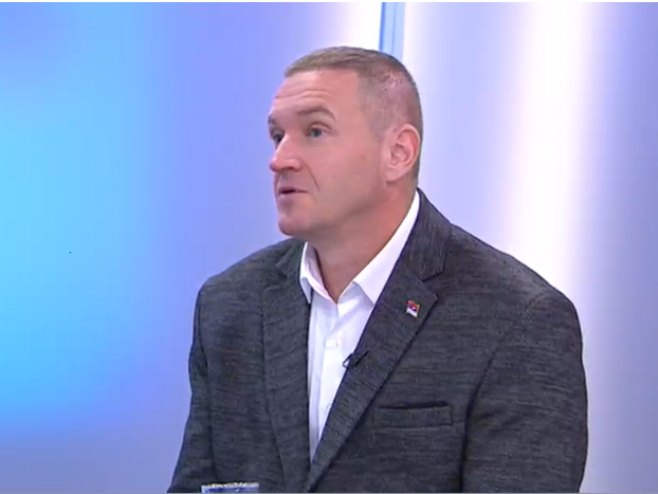
Goran Broćeta, a delegate in the House of Peoples of the Parliament of the Federation of Bosnia and Herzegovina, said in RTRS’s morning program that trust and coexistence are becoming increasingly difficult in the Federation.
“Vandals are showing hatred more and more often, and they are choosing neither the place nor the time when desecrating property in the Federation of Bosnia and Herzegovina. We must not allow such incidents to pass without consequence, because Serbs in Bosnia and Herzegovina should feel safe,” Broćeta said.
According to him, all of this is happening under the narrative of coexistence coming from Sarajevo.
“There are also systemic attacks that remain under a veil of secrecy. Federal Minister Ramo Isak does not react to any of these incidents and does not want to contribute to coexistence and the building of trust in Bosnia and Herzegovina,” Broćeta said.
He added that the goal is for Serbs to disappear from the Federation of Bosnia and Herzegovina, and that their number there is decreasing by the day.
“Where Serbs live in more homogeneous communities, such as Drvar and Grahovo, they manage to secure certain benefits for life there. If it were not for Republika Srpska helping Serbs in the Federation of Bosnia and Herzegovina, life there would be unbearable. In those municipalities, the outflow of population has been stopped. Younger families are returning to Drvar. In every possible way, we are trying to keep people in those areas,” Broćeta said.
He also pointed to major problems with Croatia.
“If you say something they do not like, you will have problems crossing the border. Imagine how far their measures of prohibition go. On the other hand, the story from Republika Srpska is completely different, because messages of reconciliation come from here,” Broćeta said.
Source: RTRS