

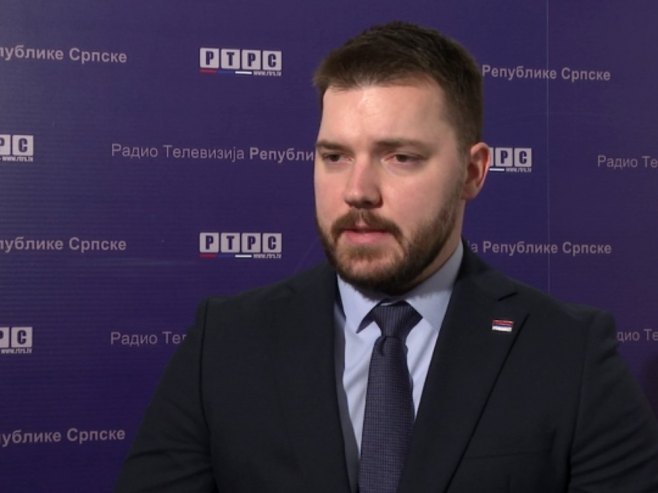
To avoid future economic crises like the one in 2008, central bankers should be encouraged to think beyond dominant economic frameworks, and war simulations could serve as a valuable intellectual tool, said international and economic policy expert Nemanja Plotan.
“Imagine being an economist in a central bank, and instead of staring at Excel tables and complex econometric models, you’re looking at a world map with plastic tanks on it, dice in your hand. In front of you is a map of the popular game ‘Risk,’ adapted to real-world conditions. However, your goal is not to conquer the world, but to maintain the stability of a national economy while the entire board is shaking. Beyond being a fun team-building activity, this could very well be the future of monetary policy,” Plotan wrote in his column.
Traditional macroeconomic models, he argues, analyze an almost perfectly ordered world—which reality clearly is not. Geopolitical shocks now spread to financial markets and the real economy within minutes, while the full effects of monetary policy still take around 18 months to materialize.
From the war in Ukraine and US-China rivalry to sanctions, global geopolitical challenges increasingly resemble strategic games rather than textbook economic scenarios.
Plotan suggests that central banks could borrow from military practices and adopt war simulations to prepare for external shocks, market disruptions, and economic downturns.
War simulations—similar to games like “Risk”—include maps, realistic scenarios, multiple players, defined rules, real objectives, and an element of randomness.
The UK Ministry of Defence defines such simulations as “a decision-making technique that provides a structured yet intellectually liberating environment in which it is safe to make mistakes in order to test what works and what doesn’t, usually at relatively low cost.”
He recalls that in the 1960s, the Pentagon conducted secret simulations (“Sigma I-64” and “Sigma II-64”) to predict the outcome of the Vietnam War. These simulations accurately forecast key developments, including the limits of military success and shifting public opinion.
While simulations cannot determine precise interest rate adjustments, Plotan argues they can break the constraints of conventional models and force decision-makers to confront high-impact, uncomfortable scenarios.
Some institutions are already experimenting: the European Central Bank uses scenario analysis, the Federal Reserve conducts geopolitical risk tests, and the Bank of England studies systemic risk effects. However, these efforts remain limited and often disconnected from core policymaking.
A more ambitious approach would integrate simulations into regular monetary discussions, similar to military “red team” strategies. These exercises could bring together economists, strategists, diplomats, and technologists to explore policy responses.
In a multipolar world where monetary policy overlaps with geopolitics and security, simulations could help assess how sanctions, disrupted supply chains, election shocks, or energy crises affect economies.
Plotan emphasizes that such tools would not only anticipate geopolitical developments but also help design both conventional and unconventional monetary responses.
He recalls Queen Elizabeth II’s famous question during the 2008 crisis: “Why did no one see this coming?”—to which the British Academy later responded that the crisis resulted from “a failure of the collective imagination.”
To avoid repeating such failures, Plotan argues, central bankers must expand their thinking—and war simulations offer one possible path.
He notes that the Central Bank of Bosnia and Herzegovina and the National Bank of Serbia already include geopolitical risks in their analyses, shaped by past experiences such as the hyperinflation of the 1990s.
However, adopting more advanced simulations—bringing together experts from economics, diplomacy, energy, and security—could take preparedness to a new level.
Such simulations might model scenarios like sudden disruptions in energy supply from Russia or the Middle East, combined with new sanctions, allowing policymakers to test how inflation expectations, foreign reserves, and policy tools would respond.
“War simulations are not a guarantee of perfect decisions, but they are a powerful tool to avoid repeating historical mistakes and to finally awaken the collective imagination of economists,” Plotan concluded.
Source: RTRS