
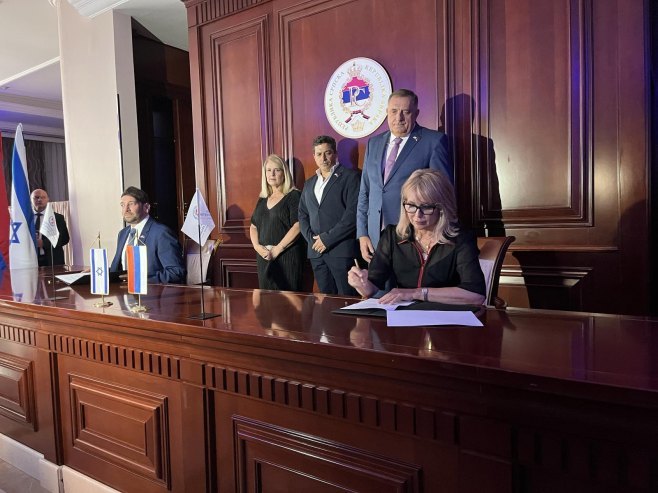


The Russian documentary film Exodus, depicting the fate of Sarajevo Serbs after the war in BiH and the exodus of more than 150,000 people following the Dayton Peace Agreement, premiered at the Cultural Center Banski Dvor in Banja Luka.
Milorad Dodik stated that Sarajevo Serbs represented a highly educated and professionally strong community, emphasizing that their departure was not only a loss of homes, but also of cultural, intellectual, and educational potential.
He noted that the suffering and exodus of Sarajevo Serbs at the end of the war were the result of complex circumstances, highlighting the strategic importance of the area and the broader geopolitical context of the 1990s.
“Sanctions and pressures faced by the Serb people show that this region was part of wider geopolitical processes. Similar patterns can be recognized today in attitudes toward Russia,” Dodik said, drawing parallels between past and present international relations.
The film is authored by Daria Grigorova, head of the Balkan bureau of the Russian state broadcaster, and produced by Russia 24.
Grigorova said she was surprised to learn about the post-Dayton fate of Sarajevo Serbs, noting that around 150,000 people were forced to leave their homes.
“I wanted to present this major human tragedy to viewers in Russia, as it is an experience relevant today. During my research, I realized how inaccurately the Western world reported on these events,” she stated.
The documentary features 16 interviews, including testimonies from witnesses and participants, archival materials, and insights from politicians, legal experts, military personnel, and contemporaries.
Georgiy Engelhardt, a senior advisor at the Russian House, said the film has already been broadcast nationally in Russia to familiarize audiences with the history of Serbs in Republika Srpska.
Among those featured in the film are Emir Kusturica and Nikola Šainović, alongside Dodik.
The documentary also explores how the events of the 1990s in the Balkans are perceived today within the context of contemporary geopolitical developments, drawing parallels between the breakup of Yugoslavia and current global conflicts, including the role of Western actors, international institutions, and mechanisms of political pressure.
It raises key questions about how decisions made at international negotiation tables shaped the destinies of hundreds of thousands of people.
Source: RTRS