

Ranko Ristić, an active member of the Serb community in the United States and a collaborator of U.S. President Donald Trump’s administration, spent the past few days in Republika Srpska, where he discussed political and economic issues, international relations, and opportunities to strengthen cooperation between Srpska and the United States with Rod Blagojevich and Joseph Schmitz.
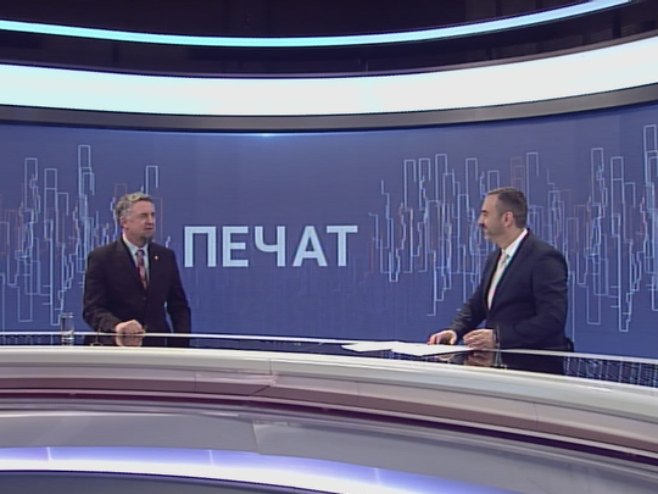
Appearing on the program Pečat, Ristić spoke about his impressions of Srpska, the Washington administration’s view of the region, the influence of the so-called “deep state,” and expectations regarding future U.S. engagement in Bosnia and Herzegovina.
He said that he is returning to America with something that America currently lacks—a return to Christian values.
“Mr. Rod Blagojevich is of Serb origin, and Schmitz is here for the first time and, by his own impressions, is delighted. I am proud when someone who comes to Srpska for the first time feels the spirit of Christianity. That is something extraordinary. We also experienced a white Christmas, which further enhanced the impression. We attended the ceremonial academy and the celebration of Republika Srpska Day,” Ristić said.
He recalled that Schmitz is a close associate of Donald Trump, who held a very senior position during Trump’s first term and was among his first advisers.
“Today he works within a non-governmental organization that cooperates closely with Trump, specifically on the issue of the autopen—machine signatures. That is the connection that brought him here, because the Serb people were victims of sanctions. He knew little about Serbs, and we actually like it when people in America do not know much about Serbs, because they have not been exposed to decades of anti-Serb campaigns. But after just a few moments, he said he felt at home,” Ristić emphasized.
Asked whether the “deep state” has influence in the United States, Ristić said that Trump himself is fully aware of it and fights it on a daily basis.
“One of the biggest indicators is the autopen. Under U.S. law, the autopen is permitted, but only with clear evidence of a presidential order. In this case, such evidence does not exist, and Trump considers this the biggest scandal in America—that documents which sometimes decide people’s lives are being signed without the president’s authorization. That is what is called the deep state. He has announced that he will annul all orders signed by autopen. That will cause a major chain reaction. Sanctions have already been lifted, fortunately. Major changes are coming soon, and they will not be signed by autopen. Trump likes to hand-sign all documents,” Ristić said.
Regarding Trump’s announcements that internal issues should be resolved by domestic politicians, Ristić noted that this primarily concerns reduced military engagement.
“President Trump puts the economy first and believes cooperation should be built through economic ties, not through changing governments as previous administrations did. That gives us a major opportunity for economic cooperation,” Ristić said.
Referring to earlier statements by Rod Blagojevich that he would advocate ending funding for the Office of the High Representative and fully closing the position, Ristić added that both he and Blagojevich are U.S. taxpayers and are therefore sensitive to how their money is spent.
“Especially when it is spent on something that is not in the interest of our country. After 30 years, the OHR no longer needs to exist. I believe people here are capable of reaching agreements on their own and building their future. Once the foreign factor is removed, all peoples here will reach an understanding. Until then, Srpska must put its interests first. I believe people understand that, and we hope for better cooperation with America. I am convinced that the OHR will no longer have a place here,” Ristić said.
He supported this view by noting that when America withdraws from an organization, such organizations tend to cease to exist very quickly.
Speaking about the withdrawal of ambassadors, Ristić recalled that around 30 ambassadors were recalled in a single day, adding that Trump understands the existence of the deep state and that remnants of the Biden administration are entrenched within the State Department.
“In that case, it is better to have no ambassador than to have one who causes damage. It would be in the interest of both America and Bosnia and Herzegovina to appoint a new ambassador who will follow Trump’s policy. I did not follow the previous ambassador earlier, and especially not now. He is at the end of his career and is trying to remain relevant. It is possible there is also a financial motive, since diplomats often become lobbyists or move into the private sector after major posts. I believe this is a personal interest,” Ristić said.
He believes Republika Srpska should be a partner of the United States and that Srpska has already given a great deal.
“We all know that Srpska has given a lot and that it withdrew its elected president. Dodik did that to preserve stability, and by doing so he has already given a great deal. Media stories suggesting that something else may have been given do not strike me as accurate. Only a partnership agreement can be reached from which both Republika Srpska and America will benefit. Today, America produces more oil and natural gas than Saudi Arabia and Russia combined. Srpska should use its resources in the best possible way, and if America is the partner—that is even better. I do not believe anything has been given away; rather, mutual cooperation is being established,” Ristić said.
He also believes that foreign investment in Republika Srpska is very likely, noting that offices already exist within the administration that promote U.S. companies and investments abroad, and he expects this to materialize as early as this year.
“I believe Srpska represents one of the few territories in Europe that has preserved traditional values. The EU has already strayed from those values by accepting large numbers of migrants who have not assimilated but instead change their environment to suit themselves. Those who lead the EU cooperate with them, while Christianity is at its lowest level. In Srpska, we see that for Christmas and St. Stephen’s Day these values are still being upheld,” Ristić said.
He also reflected on current global challenges, which he believes signal a shift in policy.
“The EU is increasingly no longer viewed as an ally of the United States on many issues. The Christian aspect is very important to Trump—he declared Christmas a three-day holiday. J.D. Vance’s speech in Munich in February was the first warning that the EU should not remove democratically elected leaders. That happened in Republika Srpska and Romania, and in Slovakia there was an attempted assassination of the prime minister. Either the EU will change its policy, or the United States will distance itself from the EU,” Ristić said.
Regarding the conflict in Ukraine, Ristić believes Ukraine is not the one prolonging the war.
“You saw it yourselves—when Zelensky first met at the White House, it seemed the war would end that very day. However, after the second meeting with European leaders, it became clear who is actually driving the war in Ukraine. America’s interest is not to prolong the war. Trump works every day to stop the killing. I am optimistic that the war will end this year, and that this is in the interest above all of the Ukrainian people,” Ristić concluded.
Source: RTRS