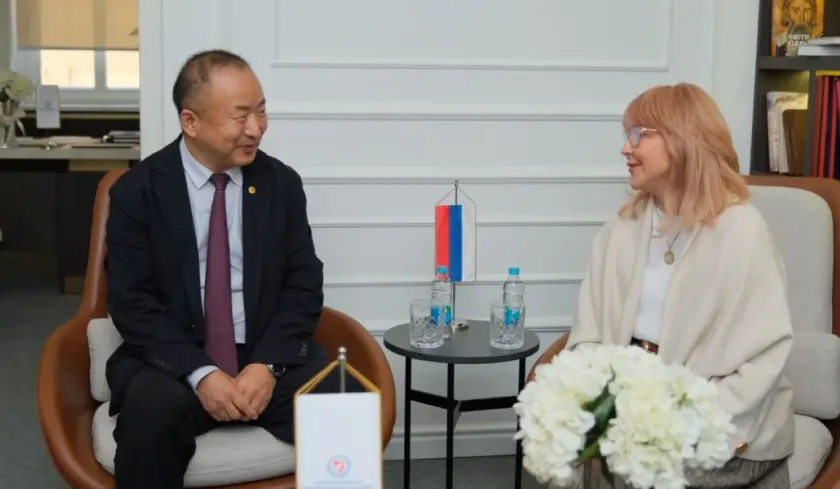


The World Center for Sinology in Beijing has published an extensive report on the visit by the Center’s director, Professor Xu Baofeng, to the Republika Srpska Office for International Cooperation, highlighting prospects for long-term institutional cooperation and for strengthening Republika Srpska’s profile in China.
The text, published on the Chinese platform WeChat, stresses the importance of further strengthening cooperation between Republika Srpska and China in science, education and culture, with particular emphasis on establishing long-term, institutionalized mechanisms of cooperation between the World Center for Sinology and the Republika Srpska Office for International Cooperation.
The World Center for Sinology reports that the Office’s director, Ana Trišić Babić, a former acting President of Republika Srpska, pointed to the importance of the Center as an international academic network and an important partner of Republika Srpska. She stressed that, from the standpoint of international cooperation, academic and cultural exchange are just as important as political and economic relations and contribute to strengthening mutual understanding and trust among people.
The report singles out Trišić Babić’s message about the two-way nature of cooperation, which, besides expanding China’s presence and visibility in Republika Srpska, also means greater visibility, better knowledge and a stronger profile for Republika Srpska in China.
She said she expects that, building on existing cooperation with the University of Banja Luka, the institutional framework of cooperation will be further expanded and new opportunities created for knowledge exchange, reciprocal visits by young scholars and cultural exchange.
According to the report, Professor Xu said that his visit to the Office is not just an academic exchange within the Fourth China-Balkans Conference on Sinology, but also an important opportunity to review the existing foundations of cooperation and to plan long-term links between the two sides.
Xu noted that the Balkans, with their rich historical heritage and interweaving of different cultures, are an important center of civilizational dialogue between China and Europe.
He stressed that the World Center for Sinology is continuously committed to building an academic platform that transcends linguistic and geographic boundaries, to developing sinological research around the world, and to deepening understanding and mutual learning among different civilizations.
The text also notes the director’s commitment to further links with the Republika Srpska Office for International Cooperation and to establishing stable cooperation mechanisms in linking academic institutions, reciprocal visits by young scholars, translation and presentation of academic publications, thematic research and cultural exchange, so that cooperation is both dynamic and effective in the long term.
Xu stressed that academic exchange is a two-way process and that the aim is for Chinese language and culture to be better and more deeply understood in Republika Srpska, and also for the rich academic tradition and cultural experience of the Balkan region to be better known and studied in Chinese academic circles.
He called on scholars and students from Republika Srpska to join the Center’s international sinological network and to contribute together to the spread of knowledge and mutual learning among civilizations.
Source: Srpska National