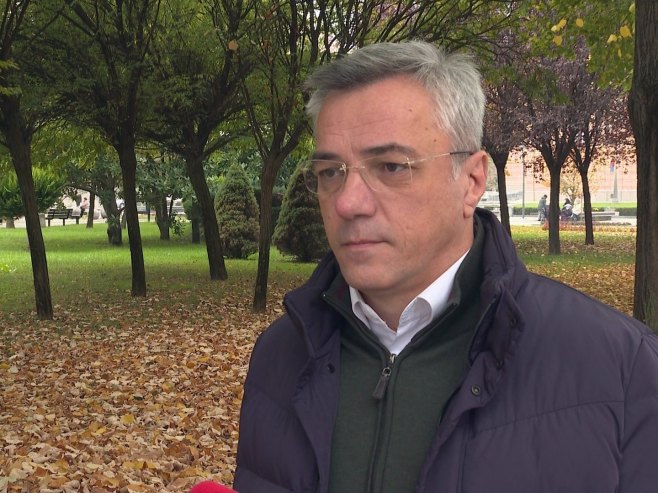

The United Nations Security Council is considering yet another report submitted by the Office of the High Representative (OHR) for Bosnia and Herzegovina (BiH), Ognjen Tadić noted in his latest opinion piece, questioning the European Union’s political consistency in supporting international supervision in BiH while simultaneously seeking greater strategic independence for itself.
The full opinion piece follows:
Once again, the discussion is taking place in an atmosphere of disagreement between those advocating the abolition of the High Representative’s position and the emancipation of BiH, on the one hand, and those supporting the continued existence of that position and international tutelage over BiH, on the other.
The absurdity lies in the fact that the latter position is predominantly supported by major EU countries.
At the same time that they defend the institution of foreign tutelage in BiH, these countries are doing everything possible to establish their own system of power within the European Union, covering defense, common foreign policy, domestic affairs, social policy and economic policy, in order to achieve political independence from the United States and other major independent world powers.
They are attempting to free themselves from tutelage while maintaining it in BiH.
This contradiction represents one of the European Union’s greatest problems of political consistency.
Ruthless geopolitics
Viewed from the perspective of the postwar international order, Europe has not been entirely free from the military and political tutelage of major independent world powers since 1945.
The United States exercised decisive influence over one part of the continent, while the Soviet Union dominated another.
Europe’s division was simultaneously a division of sovereignty, security and economic interests, and political independence.
With the fall of the Berlin Wall and the dissolution of the Warsaw Pact, many expected an era of complete emancipation for European countries.
However, instead of becoming a continent of independent political actors or an alliance of such states, Europe largely remained within a security and political system whose principal pillar was the United States.
Following the collapse of the Eastern Bloc, the American military presence expanded, either directly or through NATO, making US influence dominant across almost the entire continent.
That influence was further strengthened and expanded following the outbreak of the conflict in Ukraine.
Today, with the exceptions of Russia and Belarus, European countries largely operate within the framework of the United States’ strategic presence.
The European Union naturally seeks to establish itself as an equal global political actor, capable of independently defining its interests in relations with the United States, Russia, China and other major powers.
European emancipation is not merely a question of economic strength, a common market or institutional organization.
Economically, such an ambition is achievable.
Politically and militarily, however, it encounters far more serious obstacles.
Put simply, the EU has been unable to develop a political discourse from which it could begin building genuine independence.
Its political power seems to move constantly between Brussels, London, Berlin and Paris, yet none of these centers has succeeded in presenting a clear and consistent vision of European emancipation.
This clearly demonstrates that, despite working toward strategic autonomy, common defense and a unified foreign policy, the European Union still struggles to imagine its own security, political stability and economic stability outside the strategic framework established by the United States.
The EU’s paradoxical policy toward BiH
If the European Union were thinking strategically about its own interests, it would have to recognize that its objective in BiH should not be preserving the position of High Representative but abolishing it.
BiH has remained under its current international arrangements since 1995, when the arrival of the High Representative and the Implementation Force (IFOR) established the postwar framework.
Instead of gradually evolving into support for the development of domestic institutions and their ability to function independently, the international presence developed into a prolonged system of political supervision, control and foreign decision-making that discredits democratically elected and constitutionally competent institutions.
The Dayton conditions for abolishing the position of High Representative have long been fulfilled.
Peace has been established, political stability has been secured, and the institutions envisaged by the Dayton Agreement have been built.
Abolishing the position of High Representative in BiH should now serve as proof that a European country can function without a foreign political tutor.
Instead, by supporting the continued presence of the High Representative, the European Union constantly produces arguments that, through political analogy, can also be directed against itself.
If BiH is incapable of functioning without a High Representative, why should anyone argue that European countries do not need an external security and political tutor?
Similarly, if a foreign authority needs to impose decisions in BiH, why should Washington’s authority over Brussels, Berlin or Paris be questioned?
Not all tutors are the same, nor are the results of tutelage
Naturally, BiH’s economic, institutional and social circumstances are not identical to those of Europe’s leading countries.
However, neither are their tutors comparable, nor are the historical results of different forms of tutelage.
The best historical example is Germany’s experience.
Following the Second World War, western Germany had the opportunity to base its postwar development heavily on the United States, a country that introduced principles of efficiency, entrepreneurship, the rule of law and respect for human rights into Germany’s political and institutional system.
This does not mean that the American presence was free from its own interests.
However, it does mean that the quality of the political model introduced by a particular tutor must also be considered.
At the same time, in eastern Germany, the same people, sharing the same historical and cultural roots, lived under a different political system and a different tutor.
The Federal Republic of Germany and the German Democratic Republic did not achieve the same results, either economically or in other areas of political development.
The difference did not lie in the people themselves but in the systems, institutions and political models established over them.
In BiH, the most significant share of political influence within the framework of international tutelage has been associated with Germany and its political and economic approach to the region.
This raises a legitimate question: why has the German geopolitical school, with its historical prejudices, mistaken assessments and Balkan stereotypes, once again been given the opportunity to demonstrate its inability to understand BiH’s complex constitutional and national structure?
Former High Representatives Wolfgang Petritsch, Valentin Inzko and Christian Schwarz-Schilling were not immune to the shortcomings and weaknesses of traditional German policy toward the Balkans and BiH.
This was particularly true, in my view, of Christian Schmidt, whom I regard as an unlawful usurper of the High Representative’s position.
Several other individuals who held the position and did not come from the German-speaking world, including Carlos Westendorp, Paddy Ashdown and Miroslav Lajčák, were also strongly influenced by Germany, either directly or indirectly through the so-called European approach.
Therefore, the results of tutelage depend not only on the people subjected to it but also on the political and civilizational model of the tutor.
Genuine European emancipation is impossible without abolishing the High Representative
It is high time for the European Union to change its policy toward the High Representative.
Not because BiH has no problems, but because the High Representative has long since exhausted anything constructive it could offer the country and now merely creates additional problems.
Abolishing the position of High Representative would represent far more than an administrative or diplomatic measure.
It would be an act carrying a clear symbolic message: the era of political tutors on European soil is coming to an end, and the era of genuine emancipation is beginning.
Only then would discussions about a united Europe, common military forces, a unified foreign policy and an equal economic space acquire full political credibility.
Europe will not achieve emancipation simply because all its countries adopt identical political positions.
Genuine emancipation will exist only when all European countries are capable of independently making and implementing their own decisions.
The European Union’s approach to abolishing the position of High Representative in BiH could become a serious test of that very ability.
Source: RTRS