
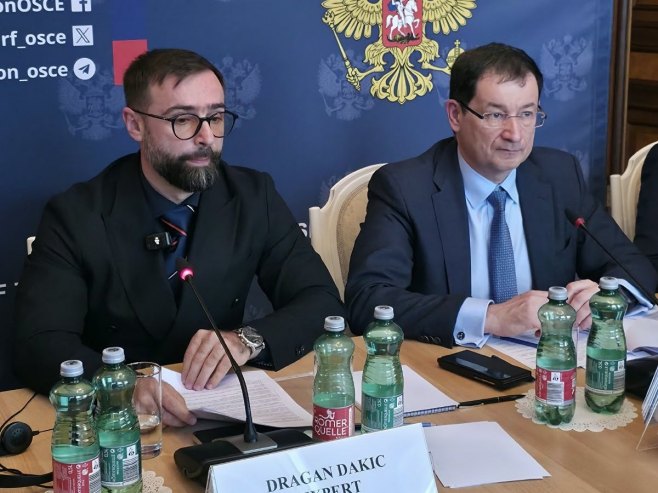
Dragan Dakić, International Law Adviser to the President of the National Assembly of Republika Srpska, has raised concerns at the Organization for Security and Co-operation in Europe (OSCE) headquarters in Vienna over externally imposed electoral legislation in BiH, the suspension of public funding for two political parties and restrictions on political expression.
Speaking during an OSCE human dimension discussion organized by the Permanent Mission of the Russian Federation to the OSCE, Dakić questioned how international election observers should assess elections conducted by domestic institutions when important electoral rules and conditions remain subject to decisions made by external authorities.
He identified three interconnected issues: amendments to BiH’s election legislation imposed by Christian Schmidt, the suspension of public funding for the Alliance of Independent Social Democrats (SNSD) and United Srpska (US), and restrictions on political communication.
Dakić questions Schmidt’s imposed amendments to BiH election law
Dakić first addressed the intervention by Christian Schmidt in BiH’s electoral legislation.
He recalled that a decision issued on March 26, 2024, introduced extensive amendments to the Election Law of BiH, including provisions concerning pilot projects involving election technologies.
According to Dakić, preliminary findings by international election observers concerning the 2026 elections also raised concerns about this approach.
“The preliminary findings of international observers for the 2026 elections recognize this problem. They criticize the establishment of the legal basis and financing of election technologies through amendments imposed by the Office of the High Representative (OHR), without parliamentary procedure or broad political consensus, assessing this as contrary to OSCE commitments,” Dakić said.
He emphasized that these findings deserve serious attention.
Suspension of public funding for SNSD and United Srpska
The second issue concerned the suspension of public financing for SNSD and United Srpska.
Dakić recalled that a decision issued on April 24, 2025, suspended the payment of budget funds allocated to the two parties.
“The decision also provides that the suspended amounts do not constitute outstanding financial obligations toward the affected parties. Lifting the suspension and determining the purpose of the accumulated funds depend on further decisions by the High Representative,” he explained.
Dakić acknowledged that the OHR had presented the measure as a response to conduct it considered a threat to the Dayton Peace Agreement and the constitutional order.
However, he argued that the stated purpose did not eliminate the need to examine its consequences for political competition and potential discrimination.
“A measure adopted outside the regular electoral framework can still have significant electoral consequences, as well as broader political and social effects,” Dakić stated.
He noted that maintaining local party organizations, retaining employees, preparing political proposals and communicating regularly with citizens all require financial resources.
According to Dakić, financial restrictions can also raise concerns about unequal political influence and transparency.
He argued that a proper assessment should examine whether comparable political actors were treated differently, whether such treatment was adequately justified and proportionate, and whether effective opportunities existed to challenge the measure.
OSCE response raises questions about democratic accountability
Dakić also addressed the OSCE’s handling of the funding suspension.
He noted that the preliminary election observation findings mentioned the suspension of public financing for SNSD and United Srpska in footnote 86, meaning that the issue had not been entirely ignored.
He also referred to a letter dated May 7, 2026, in which the Head of the OSCE Mission to BiH acknowledged concerns raised by National Assembly President Nenad Stevandić regarding the suspension of budget funding.
However, according to Dakić, the response stated that matters concerning OHR decisions fell outside the OSCE Mission’s mandate.
Dakić questioned whether the inability to review or overturn an OHR decision should prevent an institution from assessing its consequences for the democratic environment.
“In my view, these are different functions. An election observer can examine the impact of a measure without claiming the authority to overturn it,” he said.
He warned that otherwise, measures affecting electoral competition could fall into an accountability gap, with domestic institutions implementing their consequences, external authorities determining their content and international observers declining substantive scrutiny because of their institutional origin.
Restrictions on political expression and social media communication
The third issue Dakić highlighted concerned restrictions on political expression in BiH.
He said preliminary election observation findings had identified concerns about broad restrictions on premature campaigning and their application to ordinary political communication, including unpaid social media posts.
“Political debate is continuous. Where the boundary between ordinary political expression and punishable campaigning becomes unpredictable, political actors may avoid lawful speech,” Dakić warned.
He argued that such restrictions could also affect voters by limiting their access to political arguments and information.
Dakić further emphasized the importance of distinguishing between false claims about election technologies and legitimate questions concerning their security, procurement, testing and transparency.
He maintained that criticism of election administration and technology should not automatically be treated as unlawful political campaigning.
Four recommendations presented to the OSCE
Concluding his address, Dakić presented four recommendations to the OSCE.
First, he called for an assessment of the electoral consequences of all significant interventions affecting political competition, including those originating from international authorities.
Second, he requested a substantive evaluation of the suspension of public financing for SNSD and United Srpska.
Third, he urged the OSCE to recommend clear and narrowly defined rules protecting political expression.
“Ordinary political debate, unpaid communication and legitimate criticism of election administration and technology must be protected against unpredictable or excessive sanctions,” Dakić emphasized.
His fourth recommendation concerned establishing a credible path toward full domestic democratic accountability.
According to Dakić, this requires domestically accountable electoral lawmaking, capable and independent election institutions, effective legal remedies and transparent coordination between the OSCE Mission and the Office for Democratic Institutions and Human Rights (ODIHR) when concerns extend across institutional boundaries.
More than 50 participants attend OSCE discussion in Vienna
The discussion brought together more than 50 participants, including Russian Deputy Foreign Minister Dmitry Yevgenyevich Lyubinsky, OSCE Permanent Council Chairperson Raphael Nägeli and Belarusian Deputy Foreign Minister Igor Sakreta.
The meeting provided an opportunity to discuss electoral governance, political rights and the role of international institutions in assessing democratic processes in BiH.
Dakić’s central argument was that international election observation should examine the practical consequences of externally imposed measures, even when observers do not possess the authority to overturn those decisions.
Source: RTRS