
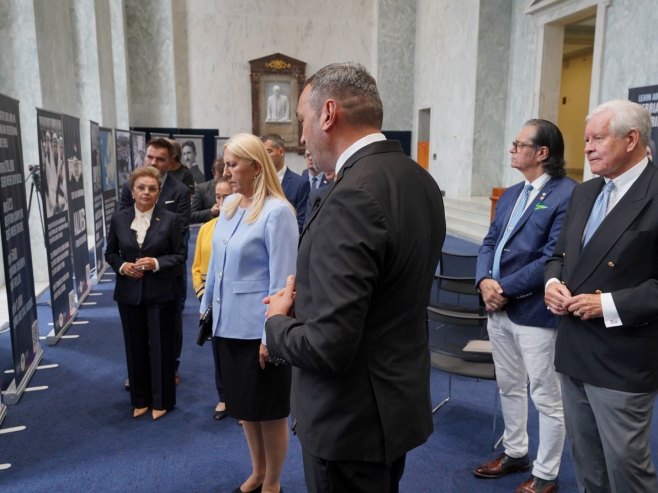
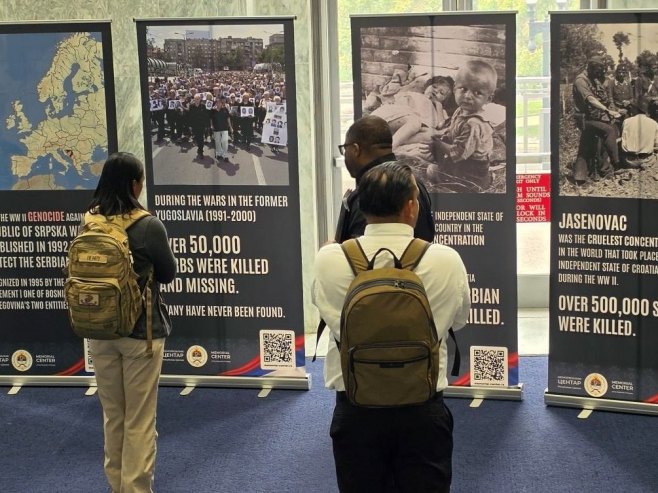
The Republika Srpska Memorial Center presented its “Meet Serb Suffering” exhibition at the U.S. Congress, bringing documents, testimonies and historical material about the suffering of the Serb people to one of the world’s most prominent political centers.
The exhibition was displayed in the Rayburn House Office Building, one of the main office buildings of the U.S. House of Representatives, which is visited daily by members of Congress, congressional staff, employees, journalists and visitors.
For the Memorial Center, Washington represents more than another destination in its international campaign, providing an opportunity to present Serb historical experiences to an audience closely connected with American political and institutional life.
The exhibition covers the suffering of the Serb people throughout the 20th century, from World War I and World War II to the wars of the 1990s. Its organizers say the aim is to bring greater attention in the United States to aspects of Serb history they believe have received insufficient attention or have often been viewed through simplified political interpretations of the wars in the former Yugoslavia.
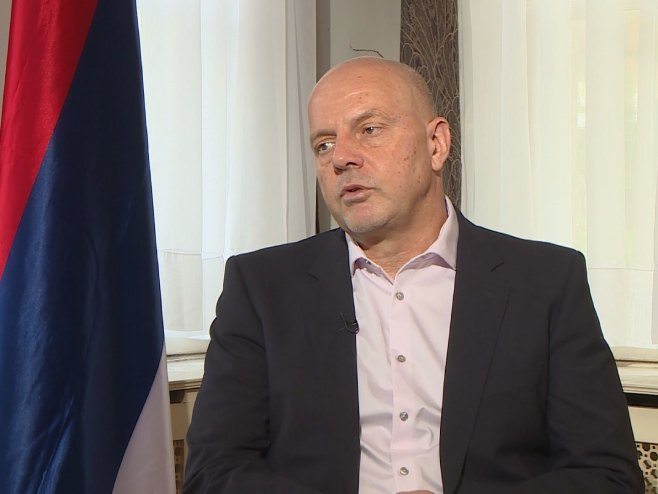
For Republika Srpska Memorial Center Director Denis Bojić, presenting the exhibition at the U.S. Congress represents an important step toward bringing the subject of Serb suffering into the American political and institutional environment.
“This is an extremely important step for Republika Srpska and for the national question of the Serb people. We have established very important contacts with significant people in the U.S. administration and received firm assurances that the issue of Serb suffering will be given greater prominence in the coming period and presented in places where our victims deserve to be remembered,” Bojić said.
He emphasized that the goal is to present Serb suffering not only as part of the history of one people, but also as a subject relevant to understanding the Balkans and broader international relations.
“Through persistent and systematic work, guided by the idea that Serb suffering is important not only for understanding the Balkans and everything that happened to us, but also for understanding international relations more broadly, we have managed to bring something that was on the margins of public awareness to a much more prominent position,” Bojić said.
Serb member of the BiH Presidency Željka Cvijanović also visited the exhibition in Washington, emphasizing the significance of its presentation at the U.S. Congress.
“I think it is very important for an exhibition like this to be presented precisely in the U.S. Congress. It gives visitors, as well as members of Congress, an opportunity to learn more about history, about Serb suffering and about certain issues that for a long time were covered by a veil of secrecy or silence, or were distorted in ways that obscured the extent of the sacrifices suffered by the Serb people,” Cvijanović said.
Speaking about an exhibition covering a century of history, Cvijanović highlighted the suffering of Serbs during World War I and World War II, while also calling for greater attention to the events of the 1990s war and the Serb victims of that conflict.
She said supporting the work of the Memorial Center is important because such exhibitions place historical events within a broader chronological and historical context rather than focusing exclusively on individual events or years.
“We must place things in a broader context and understand the scale of the sacrifice and how much injustice has been done to those victims. Their mission is to correct the injustice toward victims who have not received sufficient respect and recognition around the world,” Cvijanović said.
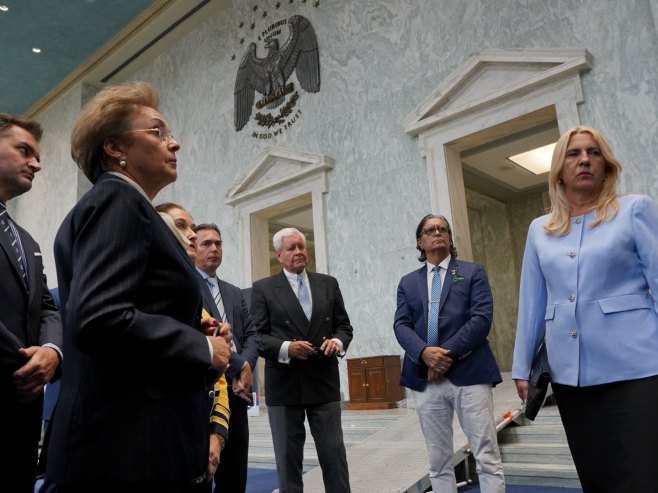
The Washington exhibition also underscores the importance its organizers place on where historical narratives are presented. Located inside the Rayburn House Office Building, the exhibition is accessible to people working within the U.S. political system.
Former U.S. Congressman Bob McEwen spoke about the importance of new generations of American political representatives becoming familiar with Serb history.
“It is important that every new generation of members of Congress, congressional staff and political leaders understands the significant role Serbia has played in economic and political development and in the struggle for peace. The whole world should know what is presented here so that such things never happen again,” McEwen said.
Visitor Brandon Welsh said the exhibition introduced him to historical material with which he had previously been unfamiliar.
“Honestly, until today I was not familiar with all of this, and I really think this is an important story that members of Congress, congressional staff and everyone passing through Rayburn today should learn about,” Welsh said.
His reaction, according to the organizers, illustrates one of the reasons the United States is an important part of the Memorial Center’s international campaign — providing direct access to audiences that may previously have had little exposure to the historical experiences presented in the exhibition.
Serbs living and working in the United States also attended the event.
Dušan Marinković, an international trade expert at the U.S. Department of Commerce, said he was already familiar with much of Serb history, but considered it particularly significant that the subject was being presented in such a prominent venue.
“I am glad this has been organized so well and that we have institutions and people who preserve the memory of the victims and organize events like this in places like this, so that the story of Serb suffering can be heard. Unfortunately, much of the world is not familiar with these issues. The more opportunities we have to talk about them, the more people will become familiar with them,” Marinković said.
He added that such events contribute to preserving historical memory and presenting perspectives that, in his view, have often received limited media attention.
Željko Damjanović, a Serb who lives and works in the United States, said public presentations are one way of making Serb historical experiences more accessible to a broader audience.
“The truth that we Serbs carry with us should be presented publicly in an appropriate way. This is one way of telling it to the world — in this case, to the United States. We Serbs also have the right to speak openly and publicly about the suffering of the Serb people in the former Yugoslavia,” Damjanović said.
He emphasized the significance of presenting the exhibition in an institution frequented by U.S. political representatives.
“It is very important that it has been displayed in an institution like this because many people pass through here, primarily politicians who work in this building. The very possibility of visiting an exhibition like this gives us an opportunity to reach those people in some way,” he said.
Damjanović added that decisions and policies made in Washington have global influence, making the U.S. Congress an especially important location for the exhibition.
The Republika Srpska Memorial Center’s international digital campaign “Meet Serb Suffering” is being presented in Washington with the support of the Republika Srpska Ministry for European Integration and International Cooperation and the Republika Srpska Representative Office in Washington.
Following presentations in New York, Vienna and Rome, the campaign has now reached one of the centers of American political life.
Drina Vlastelić Rajić, head of the Republika Srpska Representative Office in Washington, said the importance of the exhibition lies in presenting Serb history, culture and suffering to American and international audiences in a city where major international issues are discussed.
“It is particularly significant that this exhibition is being presented at the U.S. Congress in Washington, a city that brings together people from different parts of the world and where many important international issues are discussed. I believe this exhibition will help the stories of Serb victims reach people who have not previously had an opportunity to hear them,” Vlastelić Rajić said.
The Republika Srpska Memorial Center has so far collected more than 1,500 audiovisual testimonies concerning Serb suffering.
The Center says presenting these testimonies outside the Serb linguistic and political space is not simply a matter of promotion, but an effort to make documented accounts of Serb victims accessible to audiences that may previously have known little about them.
That, the organizers say, is the significance of bringing the international “Meet Serb Suffering” campaign to Washington following its presentations in New York, Vienna and Rome.
Source: RTRS