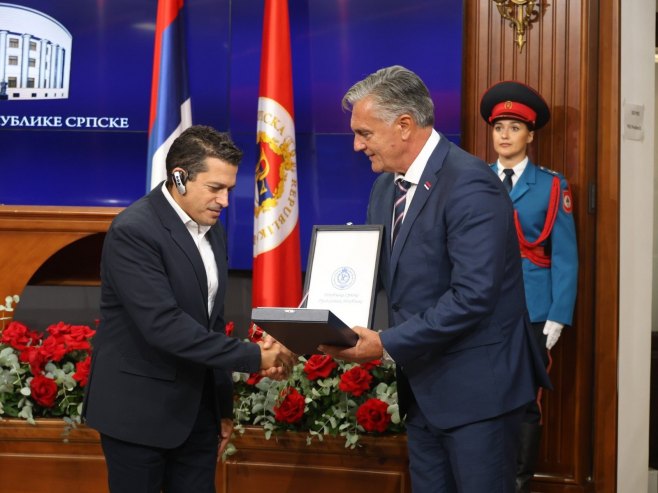


Poet and writer Boro Kapetanović has been posthumously awarded the Duško Trifunović Prize, presented by the Pale Cultural and Sports Center for contributions to the promotion of Serb culture and literature.
The award was accepted on Kapetanović’s behalf by his brother Duško during a literary and poetry evening. He said the recognition carried special significance for him, recalling that Trifunović frequently visited their hometown of Sanski Most during the 1970s.
“Boro was very happy when he learned that he was the recipient of the Duško Trifunović Prize because he had tremendous respect for Duško and they were good friends. I am sorry that he is not here today, but that is life,” Kapetanović told reporters.
Professor Miloš Kovačević emphasized the importance of the Days of Duško Trifunović literary and poetry event, describing Trifunović as one of the rare poets whose verses are widely known, sung and embraced by the people as their own.
“If there is such a thing as a people’s poet, a poet everyone knows and whose poems are sung more often than they are read, then it is Duško Trifunović. Who has not heard of ‘Tajna veza,’ ‘Ti si bila u svemu naj, naj, naj’ and numerous other songs that became musical hits but are, in fact, Trifunović’s verses?” Kovačević said.
He noted that the enormous popularity of Trifunović’s verses makes him a unique figure in Serb poetry and culture.
“While the people know him thoroughly and sing his verses, Duško Trifunović has often been overlooked in academic and literary studies. That is why the work being done by the Pale Cultural Center is more than necessary if Trifunović is to receive the place he deserves in Serb poetry,” Kovačević said.
He added that Trifunović’s position is increasingly being affirmed through anthologies and histories of Serb literature, including children’s literature. Kovačević also welcomed the organization of roundtables and the presentation of the Duško Trifunović Prize as a way of introducing his work to new generations.
Poet Blagoje Baković said Duško Trifunović continues to live on in Pale and among his people, adding that those who receive an award bearing his name, in a sense, also receive a part of Duško because the recognition becomes an integral part of their biographies and bibliographies.
“The first roundtable dedicated to his literary work was also held today. Duško was never unrecognized, but the time has come for his work to receive recognition from an academic perspective as well. Once the papers from this roundtable are published in a collection, they will provide important material for future researchers studying his work,” Baković said.
The event is organized by the Pale Cultural and Sports Center. Its director, Slavka Brezo, said this year’s program marks the 20th anniversary of the Days of Duško Trifunović, which will last for three days and aims to preserve the memory of the renowned poet and his work.
“In this way, we keep Duško from being forgotten. We pass on his love of poetry and creativity, as well as our love for him, to future generations,” Brezo said.
Duško Trifunović was born in Sijekovac, near Brod, in 1933. He published his first book at the age of 25 after moving to Sarajevo.
He wrote around 20 books of poetry, four novels and several plays and is widely regarded as one of the key figures in the development of the Sarajevo school of rock and roll. He wrote lyrics for some of the best-known singers and rock bands of the former Yugoslavia, including Bijelo Dugme, Indexi, Zdravko Čolić and Arsen Dedić.
Trifunović is also remembered as the creator of the cult Television Sarajevo program “What Children Know About Their Homeland.”
Following the outbreak of the war in BiH in 1992, he moved to Novi Sad, where he died in 2006. He was buried in Sremski Karlovci.
Source: RTRS