


Republika Srpska President Siniša Karan said that portraying Republika Srpska as the problem in Bosnia and Herzegovina is a major misconception, arguing that it is in fact the only defender of the country’s Dayton constitutional order, although many either fail to recognize this or choose to ignore it.
Karan said Bosnia and Herzegovina must accept what it is instead of constantly attempting to become something else. He stressed that it is neither a unitary nor a single-nation state, but a complex state community composed of two entities and three equal constituent peoples.
“Successful complex states are not based on imposing one political vision on others, but on the ability to respect one another and resolve disagreements through agreement. That is why I constantly emphasize parity, consensus, and the division of competencies as the fundamental principles of a functional Bosnia and Herzegovina as a federal state,” Karan said.
According to him, the problem is not the complexity of Bosnia and Herzegovina itself, but what he described as efforts by political Sarajevo and parts of the international community to eliminate that complexity.
Karan argued that political crises have emerged because the constituent status of the peoples, entity competencies, and mechanisms designed to protect them have increasingly been treated as obstacles that should be removed.
“The formula exists and it is written into the Dayton Agreement. What is needed is the political maturity for everyone to accept parity, consensus, and the division of competencies as facts, and to understand that Bosnia and Herzegovina can function only as a community in which no one attempts to dominate anyone else,” Karan told Glas Srpske.
He said future authorities would have an obligation to the people of Republika Srpska to preserve its institutional capacity and political stability, while continuing to strengthen its economy and international position.
Karan stressed that institutions and the Dayton Peace Agreement are not only the foundation of Republika Srpska’s stability, but also the only sustainable basis for the stability of Bosnia and Herzegovina as a whole.
“We have gone through a period of major political and institutional pressure, and these circumstances have demonstrated just how important it is for Republika Srpska to have stable institutions that regularly exercise their constitutional competencies,” he said.
Such institutions, Karan added, provide the strongest guarantee that Republika Srpska can protect its interests regardless of where future challenges originate.
He said those challenges would not disappear because, in his view, the fundamental political dispute in Bosnia and Herzegovina is between two concepts: the federal model on which the Dayton Agreement is based and a unitary model seeking to concentrate power and decision-making in Sarajevo.
“Our response is a policy of responsibility and the defense of the Constitution and Dayton, because we know what our interests are, what our Dayton competencies are, and where the constitutional boundaries that cannot be crossed lie,” Karan said.
He recalled that Dayton established a system in which no constituent people can simply be outvoted and in which agreement is a prerequisite for functioning. According to Karan, its essence rests on three principles of a functional federal state: parity, consensus, and a clear division of competencies.
“All three constituent peoples agreed to such an arrangement, which established mechanisms for protecting both the peoples and the entities. There is no alternative to Dayton if we want a stable and sustainable Bosnia and Herzegovina. The question is whether all actors are genuinely prepared to implement it rather than selecting only those provisions that suit them politically,” Karan said.
According to him, when Republika Srpska defends its competencies, it is demanding respect for the rules to which all sides agreed and which brought peace.
“It is up to us to persist in that position, but it is also up to others in Bosnia and Herzegovina, as well as international actors, to accept that lasting stability cannot be built through imposition, but only through agreement,” he stated.
Asked about interventionism by high representatives and the possibility of reversing decisions imposed through the so-called Bonn Powers, Karan said any process of overturning such acts should be institutional, legally grounded, and responsible.
He argued that the Bonn Powers had been used to impose laws, remove elected officials, and substantially reshape constitutionally defined competencies, resulting in significant changes to the constitutional structure of Bosnia and Herzegovina without formally amending its Constitution.
“Our position is that Annex 10 of the Dayton Agreement does not grant the high representative legislative powers, while the Constitution of Bosnia and Herzegovina clearly defines who has the authority to adopt laws. Sovereignty in Bosnia and Herzegovina belongs to its peoples and entities, not to a foreign actor placing himself above the constitutional order,” Karan said.
Asked about Republika Srpska’s foreign policy direction, Karan said it is pursuing an active and increasingly recognizable policy of international positioning through dialogue based on the Constitution and the Dayton Peace Agreement.
He said Republika Srpska seeks dialogue and partnerships wherever common interests exist, while clearly defending its constitutional position and its right to have its own voice.
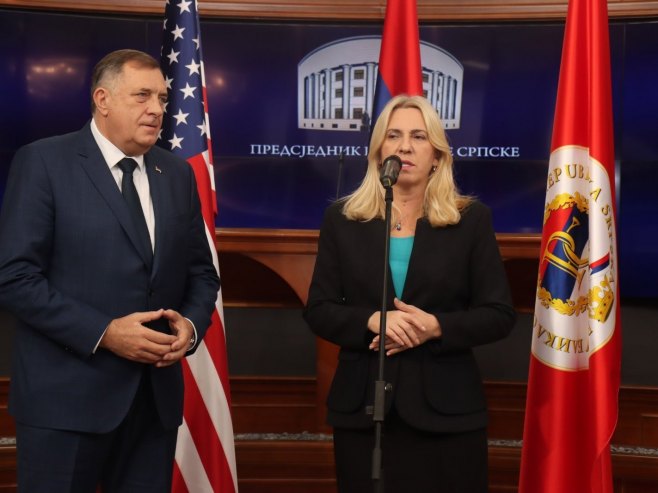
Karan highlighted the importance of international contacts maintained by Milorad Dodik, Serb member of the Bosnia and Herzegovina Presidency Željka Cvijanović, and Republika Srpska Office for International Cooperation Director Ana Trišić Babić.
“When dialogue is freed from prejudice, space opens for arguments that had been suppressed for years to finally be heard,” Karan concluded.
Source: RTRS