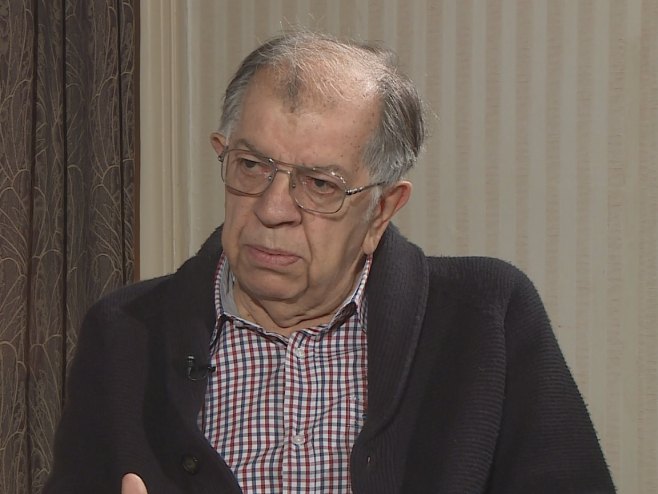




The recent session of the UN Security Council showed that major powers still hold different interests and positions regarding Bosnia and Herzegovina, despite growing discussion about reducing the role of the Office of the High Representative (OHR), says Dean of the Faculty of Law at the University of East Sarajevo, Goran Marković.
In an interview for Glas Srpske, Marković stated that the end of international diktat and the beginning of genuine domestic responsibility are inseparable processes.
“For the OHR to finally disappear, two parallel developments are necessary. Domestic political elites must fully assume responsibility for governing the country, while external actors must lose the ability to impose decisions through the OHR,” Marković said.
According to him, the original role of the High Representative under Annex 10 of the Dayton Agreement was to coordinate and assist, but the institution quickly transformed into what he described as a “sovereign authority.”
“That role caused BiH institutions to lose legitimacy, repeatedly suspended the constitutional order and convinced citizens that political participation and elections have little real impact if laws, constitutional amendments and dismissals of officials can be imposed externally,” he added.
Marković argues that the High Representative system damaged not only Republika Srpska by stripping away competencies and autonomy, but also BiH itself, because powers obtained through imposed decisions cannot create long-term political stability.
“The OHR became a creator of legal and political chaos. Political elites often use its presence as an excuse for their own inactivity, while parts of the political establishment in Sarajevo still expect foreign intervention to impose decisions they favor,” he stated.
He stressed that even if the OHR’s role is reduced rather than abolished immediately, it must be returned strictly to the framework defined by Annex 10 of the Dayton Peace Agreement.
“The High Representative should monitor, advise and assist — not govern, impose laws or remove officials. That alone would represent enormous progress compared to the current situation,” Marković said.
He also warned that political processes in BiH cannot survive on majoritarian pressure or maximalist agendas, but only through compromise and accommodation between constituent peoples.
“Agreement is the only sustainable foundation for political and social stability. Outvoting and maximalist political programs can only produce deeper crises,” Marković concluded.
Source: Glas Srpske