
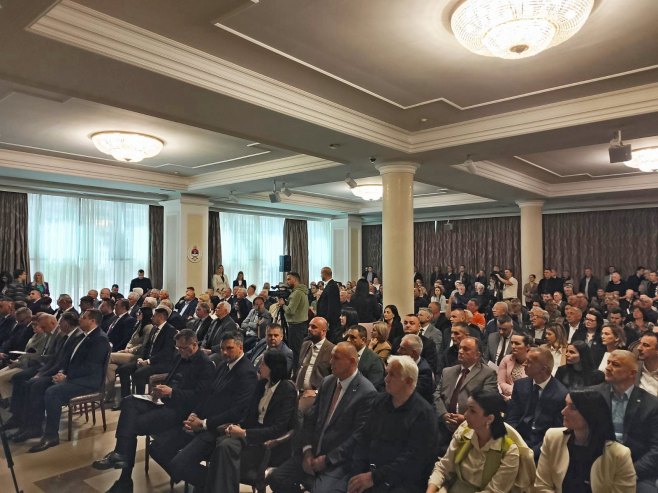
The issuing of prison sentences for genocide denial and glorification of persons convicted of war crimes, imposed by the Court of Bosnia and Herzegovina under a law introduced by Valentin Inzko, along with hundreds of criminal complaints filed on that basis, goes beyond the framework of ordinary legislative processes, participants said at a scientific conference in Banja Luka.
According to speakers, the matter represents a serious political issue with elements of historical revisionism. They argued that it not only violates one of the universal human rights — freedom of opinion — but also seeks to impose only one narrative about events in Bosnia and Herzegovina during the last war.
Representatives said Republika Srpska cannot allow this and is preparing an institutional response.
Concern among veterans
Around 300 veterans of the Army of Republika Srpska gathered in front of the Government building seeking protection from institutions. They were addressed by Prime Minister Savo Minić.
“We will no longer allow anyone to humiliate us. The best sons gave their lives for this state, and many children grew up without parents,” Minić said.
Minister of Labour and Veterans’ Protection Radan Ostojić said the criminal prosecution currently taking place, mostly against Serbs, represents an attempt at rewriting history.
“To renounce that means renouncing everything we did during four full years, renouncing our blood, our fallen brothers, our wounds, identity and history,” Ostojić said.
Institutional response announced
Minister of Justice Goran Selak said the conference was the first step and that a special session of the National Assembly could soon be convened.
“The institutions of Republika Srpska are sending the message today that we are preparing a response to unconstitutional and unlawful conduct by the judicial institutions of Bosnia and Herzegovina,” Selak said.
Minić added that this must be answered institutionally.
“This is no longer an individual case. We had an attack on the institution of the president, on the Government, and now an attack is being made on every individual who cannot express his opinion,” he said.
Freedom of expression debate
Professor of law Ljubinko Mitrović referred to European Convention on Human Rights, stating that Article 10 guarantees freedom of expression and the right to hold and voice opinions.
Historian Predrag Lozo said imposing dogmas that cannot be questioned and prescribing official truths is a retrograde act in the 21st century.
Claims of selective enforcement
Participants also argued that the disputed law is being applied selectively, claiming that similar cases in the Federation of Bosnia and Herzegovina have not been prosecuted.
As an example, they cited the marking of the Day of the 3rd Corps of the former Army of Bosnia and Herzegovina, where a promotional poster reportedly featured convicted war criminal Sakib Mahmuljin.
Branko Grahovac said identical criminal complaints had been filed in such cases as well.
Final message
The conference concluded that the response being prepared by Republika Srpska is not directed against any people or institution, but is intended to ensure equal treatment for all and protection of fundamental rights. Participants said that when criminal complaints are used as a tool of pressure rather than justice, it becomes a political misuse of the judicial system.
Source: RTRS