

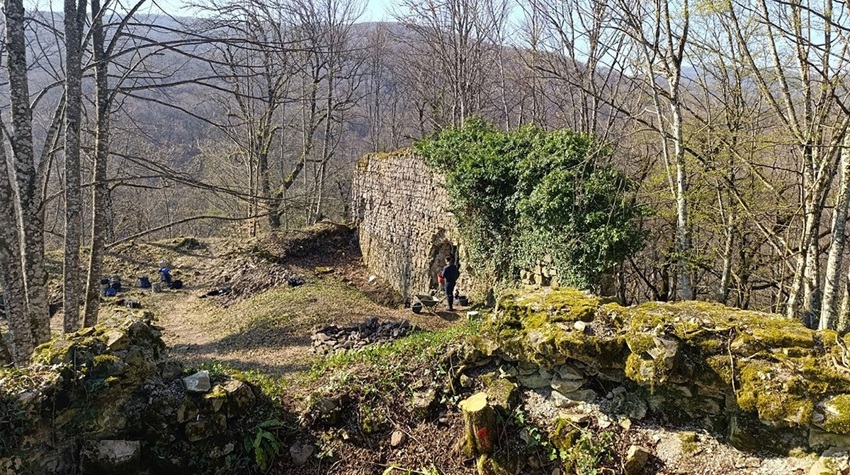

The Gradiška Heritage Museum, with the support of the City Administration and the Ministry of Education and Culture of Republika Srpska, has launched research into a 13th-century fortress in Gornji Podgradci, known as Vrbaški Grad. The project uses advanced LiDAR technology for spatial laser scanning and the creation of highly precise 3D models of terrain, land, and infrastructure.
The first results have already provided the most detailed overview to date of the fortress layout, as well as insights for further research. Current excavations, according to archaeologist Dušan Kojić, are focused on collecting data from earlier digs.
“The new approach will help us design excavation strategies and future research for this important archaeological site. We will be able to determine the appearance of the fortress, its construction structure, interior, and surroundings. By using modern technologies, we will identify phases of construction and life within the fortress,” Kojić explained.
The Archaeological Institute in Belgrade is also participating in the project alongside the Gradiška Heritage Museum.
The study of the fortress—of which the western wall and the strongest donjon tower, once the site of the last defense, have been preserved—is important, according to Uglješa Vojvodić, an archaeologist from Belgrade, for gaining new insights into defense systems and spatial security, as well as the role of the fortification in halting Ottoman advances.
First record dates back to 1244
Vrbaški Grad, located on a cliff at an altitude of 285 meters along the Gradiška–Mrakovica road, was first mentioned in a charter of Hungarian King Béla IV in 1244 as the administrative center of the Vrbas County.
According to historical records, the fortress was visited in 1398 by Holy Roman Emperor Sigismund, highlighting its significance.
The rulers of the Vrbas County, to which the fortress belonged, were the Babonić noble family. Historian Jelena Mrgić Radojčić notes that the county extended between the Moštanica River to the west, the Sava River to the north, and the Vrbas River to the east, reaching the slopes of Kozara to the south.
Vrbaški Grad, about 50 meters long and located on the hill Pavetnjak near Gornji Podgradci, was systematically researched starting in 1981 by archaeologist Milan Đurđević of the Gradiška Heritage Museum.
In his book Old Bosnian Towns, historian Hamdija Kreševljaković states that the Ottomans captured the fortress in 1537, after which its commander Andrija Radulović, unable to continue defending it, set it on fire and abandoned it.
The fortress was never rebuilt or repopulated. The western wall remains preserved, measuring 21 meters in length, 1.45 meters in thickness at the base, and between 4.3 and 5 meters in height.
At a height of four meters, evenly spaced openings measuring 24 x 12 cm run along the wall, used to support wooden structural beams for the defenders.
The medieval fortress Vrbaški Grad and the Church of St. George, which form a single unit, have been declared a national monument of Bosnia and Herzegovina.
Church of St. George
At the southern foot of Vrbaški Grad, an impressive medieval church dedicated to St. George was discovered in 2016. The structure, oriented east–west and featuring a semicircular apse, is considered one of the largest churches of its kind in the wider region.
“The church was built using roughly cut and dressed stone bonded with lime mortar, and bricks used for floor paving were also discovered,” said archaeologist Bojan Vujinović, who has been involved in researching the site for the past two decades together with experts from the Gradiška Heritage Museum.
The walls are about one meter thick, expanding to 1.6 meters at the foundation level. Its architectural features reflect a combination of Romanesque and Gothic styles.
“The appearance of such a style in sacral architecture is not unusual, as medieval builders clearly came from Western regions and Dalmatia,” Vujinović noted.
Excavations have also uncovered two of the four buttresses originally documented by Nikola Bilogrivić in 1936 during earlier research.
At the same site, a silver coin from the second half of the 15th century, belonging to Croatian-Hungarian King Matthias Corvinus—one of the most powerful and wealthy rulers of his time—was also discovered.
Origins of Podgradci
A settlement developed near the fortress and the church, believed to be the origin of present-day Gornji Podgradci. Toward the end of the Ottoman period, in 1855, a water-powered sawmill was established in Podgradci, employing not only local workers but also laborers from across the Austro-Hungarian Monarchy. This contributed to population growth and the expansion of the settlement, which has continued to develop to this day.
Source: See Srpska