

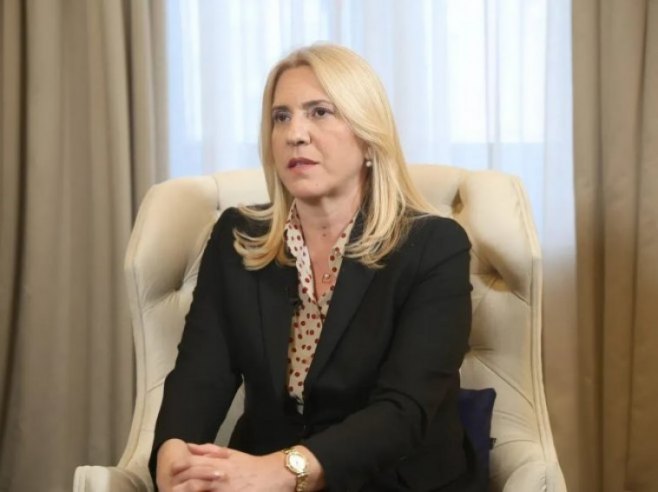
We all need to work together to preserve peace and stability. I am confident that this will be the case. We must all, of course, look at Republika Srpska in a unified way, its interests, its constitutional and political position, as well as its economic and social sphere, said the Serb member of the Presidency of Bosnia and Herzegovina, Željka Cvijanović, in an interview for Glas Srpske.
She also noted that there is a growing awareness in the world of what the problems of Bosnia and Herzegovina actually are.
“There is also a growing awareness that Republika Srpska is defending itself. I have heard at many important addresses that Sarajevo will have to recognize and acknowledge Republika Srpska. These are things that are very different compared to what we used to hear before. The whole world is changing, but in Bosnia and Herzegovina it seems that not everyone understands that this is happening,” Cvijanović said, expressing hope that in the new year all citizens and institutions of Republika Srpska will record progress.
At the end of last year, you told us that there is a recipe for a better future for everyone in Bosnia and Herzegovina. Has that recipe been applied?
“When I look at the past year, it is clear that the recipe has not been applied and that there are those who are unwilling to do anything in that regard, to improve things or reach agreements that would lead us into calmer waters. If we look at how this year unfolded, how many challenges there were, and how many imposed and unconstitutional measures were dictated by foreign actors, primarily Christian Schmidt, then we can see that Bosnia and Herzegovina has sunk into yet another serious crisis. It is a state of lethargy, of the absence of dialogue and compromise. It is difficult to establish genuine communication with political Sarajevo because their political ambitions far exceed what belongs to them under the Constitution. That is the core of the problem. At the same time, part of the international community encourages these ambitions, which further complicates the situation.”
Why is there no interest in progress?
“Everyone views this from their own perspective. In political Sarajevo, they believe that centralization is the solution — transferring competencies to the level of Bosnia and Herzegovina and governing through foreign mechanisms such as the High Representative and foreign judges in the Constitutional Court. That reliance on foreign intervention prevents the country from functioning independently. Institutions that are democratically elected must have real authority. No one should stand above them. What we have seen over the past year and earlier shows that we are completely out of sync. Republika Srpska believes in working within constitutional competencies and dialogue, even when disagreements exist. Sarajevo, however, relies on interventions that are often brutal and unprecedented in the modern world.”
And that leads nowhere?
“Of course not. The country is stagnating. At the same time, many important issues are neglected, especially economic ones. Instead of focusing on development, everything is subordinated to political ambitions and foreign interference. A state cannot function normally under such conditions. That is why it is our responsibility, as representatives of Republika Srpska at the joint level, to compensate for the lack of dialogue and to strengthen what is working well in Republika Srpska. The Government of Republika Srpska is functioning at full capacity, increasing salaries and pensions, and attracting investments. We even have examples of foreign companies relocating their production to Republika Srpska, such as an Israeli company that will employ 150 workers.”
Can Bosnia and Herzegovina survive without respecting the Dayton principles?
“No, it cannot. The fundamental principles of constitutional order must be respected — equality of constituent peoples and entities. Bosnia and Herzegovina was established as a complex state consisting of Republika Srpska, the Federation of BiH, and the Brčko District. Any attempt to centralize or militarize the country violates those principles and leads to instability. Everything Republika Srpska has done over the past 30 years has been a struggle against unconstitutional centralization imposed through foreign interventions. Experience has shown that such policies are counterproductive. We must return to the Dayton framework if the country is to function.”
You were outvoted several times in the Presidency, including on the budget. What does that show?
“It shows that constitutional protection mechanisms are essential. Without them, Republika Srpska would be completely overruled. These mechanisms exist for a reason — to ensure balance and equality. Bosnia and Herzegovina can function only within the framework established by Dayton. Any attempt to change that leads to instability.”
How has the verdict against Milorad Dodik affected the position of Republika Srpska?
“The intention behind that process was to undermine the institutions of Republika Srpska. It was never a legitimate legal process. It was a political intervention aimed at weakening the President, the Government, and the National Assembly. But we have endured. Institutions continue to function, and we are determined to protect them. These pressures have only strengthened our resolve.”
Was it right to withdraw certain laws and conclusions adopted by the National Assembly?
“Yes. It was right both when they were adopted and when they were withdrawn. Each decision had its purpose. The National Assembly acted responsibly and courageously. Those steps helped draw international attention to the real problems in Bosnia and Herzegovina. Today there is far greater understanding of the position of Republika Srpska.”
Did the international community hear your message at the UN?
“More than ever before. The message was clear, and it reached those who are now in positions of power. Today, there is a more balanced approach. The emphasis is increasingly on dialogue and consensus, rather than on imposing solutions.”
Does Bosnia and Herzegovina still have time to apply the ‘recipe’ you mentioned?
“That depends on political will. Republika Srpska is ready for dialogue and compromise, but it will not give up its constitutional rights. We do not seek to take anything from others, but we will not allow what belongs to us to be taken away either. Solutions must come from domestic institutions, not imposed from outside.”
How do you view the blocking of joint projects with Serbia, such as the Trebinje airport?
“These are typical obstructions coming from Sarajevo. The same applies to projects like the Buk Bijela hydropower plant. Republika Srpska will have to find ways to implement key projects independently if necessary. Development cannot be held hostage to political blockades.”
In conclusion, Cvijanović emphasized that Republika Srpska remains committed to peace, dialogue, and constitutional order, but will firmly defend its rights and position.
“The world is changing. Republika Srpska understands that. The question is how long others will need to realize it as well.”
Source: RTRS