

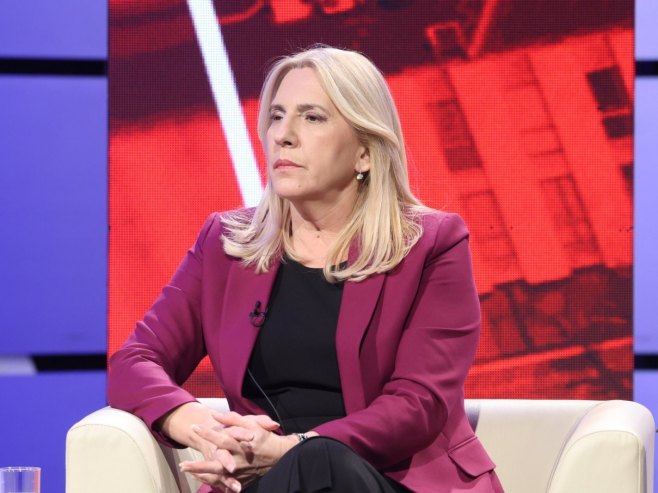
Speaking about the new U.S. administration led by President Donald Trump, Serb member of the BiH Presidency Željka Cvijanović told Radio Srpska that Republika Srpska appreciates a balanced approach and a policy that does not favor anyone. She added that she has not met a single representative of the new administration who praises the Bonn Powers or believes that an individual can stand above democratically elected institutions.
“We have seen a clear change in attitude—they want no one to be ‘the one on the bottom.’ Sanctions imposed on individuals and legal entities were lifted, and I am grateful for that. It was a gesture showing they do not want anyone from Srpska to face restrictions, and that is a fair approach,” Cvijanović said.
She noted that the current U.S. policy is not primarily focused on the Balkans, that it is more even-handed and does not favor any side. That, she emphasized, is exactly what Republika Srpska has been asking for—not to be sidelined, as was the case in previous years.
Cvijanović said she is grateful for the shift in approach, emphasizing that the new administration does not want anyone from Republika Srpska to face limitations compared to others coming from the Federation of BiH or from other national groups.
She added that the current administration recognizes which policies are outdated and which limitations hold BiH back. In the new structure, she has not heard anyone express admiration for the Bonn Powers; instead, the views were the opposite.
According to her, the current U.S. administration does not believe it is acceptable for an unelected individual to stand above democratic institutions and act as if he were a parliament, a government, or a financial authority—referring to Christian Schmidt.
“These are definitely positive and favorable developments for me. They show that the attitude toward democracy is much healthier, more normal, and more mature than what we have heard in the past,” Cvijanović said, adding that she expects further positive steps from the U.S. administration in the future.
Cvijanović also noted that she visited Zagreb for the anniversary of the Dayton Agreement, where she met with the U.S. ambassador to Croatia, appointed by the new administration.
“We had a pleasant conversation. The ambassador advocates economic diplomacy, de-escalation, and a focus on investments. That would be a new approach. Currently, embassies in the region operate under chargés d’affaires. When we will have an ambassador in BiH, I do not know, but cooperation is good,” she said.
She added that there is interest in the Southern Interconnection gas project.
“That project should demonstrate economic and investment presence. I expect it will expand further—it is certainly an important topic,” Cvijanović stated.
Commenting on the first 100 days of the new Government of Republika Srpska, she said the performance has been very good given the challenging circumstances.
“The Government and the Prime Minister have shown commitment to progress, cooperation with trade unions, employers, veterans’ associations, and social groups. They have been active and are handling challenges successfully,” she emphasized.
Speaking about the EU–Western Balkans Summit, Cvijanović also referenced the decision of Serbian President Aleksandar Vučić not to attend.
“We saw his statement, and as the president of the strongest country in the Western Balkans—already deeply familiar with the accession process—he certainly knows why he made that decision,” she said.
Regarding BiH, she noted that the Chairman of the Presidency was invited to the summit.
“Everyone knows that if the Chairman does not have an agreement with the other two members, he cannot present the position of BiH—only his personal stance,” Cvijanović concluded.
Source: RTRS