

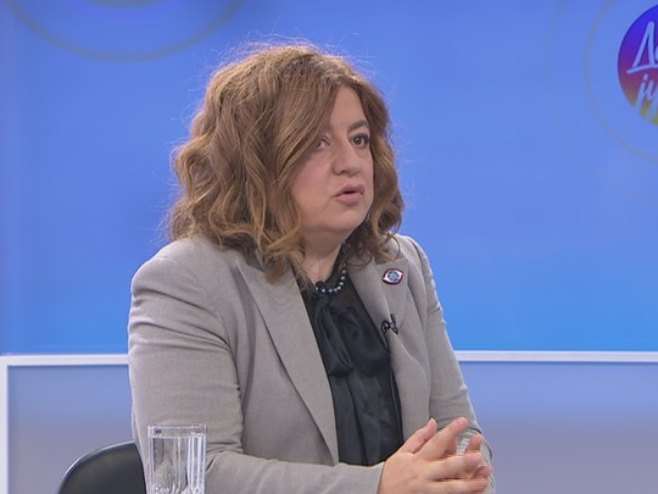
Nina Sajić, professor at the Faculty of Political Sciences at the University of Banja Luka, has expressed hope that the permanent members of the United Nations Security Council will recognize that genuine stability and progress in BiH cannot be achieved without closing the Office of the High Representative (OHR).
Speaking on RTRS’s morning program ahead of the UN Security Council session on the situation in BiH, Sajić criticized the latest OHR report, arguing that it continues to portray Republika Srpska as responsible for the country’s political difficulties.
“What we have seen in the OHR report is more or less what we have become accustomed to. We would have been surprised if anything different had been written,” Sajić stated.
She argued that the report follows a familiar narrative in which Republika Srpska is blamed for everything that does not function properly in BiH.
Sajić: Functionality should not be equated with centralization
According to Sajić, international discussions about BiH’s political system have increasingly equated institutional functionality with greater centralization.
“For approximately the past ten years, we have become accustomed to seeing the concept of functionality equated with centralization,” she explained.
Sajić emphasized that BiH has a federal-consociational constitutional structure that includes specific mechanisms designed to protect the interests of its constituent peoples and entities.
She argued that these constitutional safeguards are essential components of the country’s political system.
“Whenever these mechanisms are used, the OHR and certain countries and organizations interpret their use as an attack on functionality or even an attack on BiH itself,” Sajić said.
She added that this approach is also reflected in certain sections of the latest OHR report.
Russia and China expected to support closure of OHR
Discussing the positions of permanent UN Security Council members, Sajić said she expects Russia and China to maintain their established positions regarding the OHR.
“We expect to see what we have become accustomed to, namely the position of the Russian Federation, which advocates closing the OHR, as well as that of the People’s Republic of China,” she stated.
Sajić recalled that China withdrew from the Peace Implementation Council in 2000.
According to her, the decision reflected China’s foreign policy principles, particularly its commitment to non-interference in the internal affairs of other countries.
“China withdrew because such involvement was not consistent with its foreign policy principles concerning non-interference in the domestic affairs of other states,” she explained.
She also noted that Russia began expressing separate opinions within the relevant international framework in 2007.
United States also interested in political stability
Sajić pointed out that, alongside Russia and China, the United States has also demonstrated an interest in political stability and progress in BiH.
She expressed hope that this shared interest would encourage broader international recognition of the need to end the OHR’s mandate.
“We expect other members, particularly the permanent members of the Security Council, to recognize that without the departure of the OHR and the closure of its office, there can be no genuine stability or progress in BiH,” Sajić emphasized.
UN Security Council to discuss situation in BiH
The United Nations Security Council is scheduled to hold its regular session on the situation in BiH today.
The meeting forms part of the Council’s established practice of reviewing developments in the country approximately every six months.
The discussions are expected to address the political and institutional situation in BiH, including the role of the OHR and the country’s future stability.
Source: RTRS