
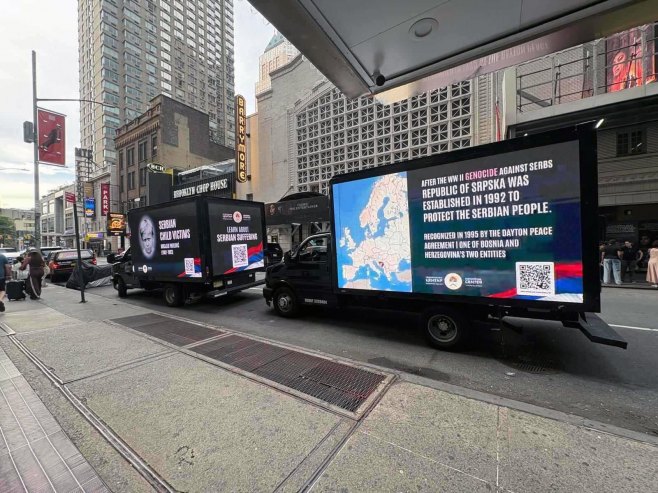
While new examples of the glorification of Ustaše ideology continue to emerge in Croatia, media outlets in the country have recently focused their attention on a campaign launched by the Republika Srpska Memorial Center.
The campaign, presented in several major cities around the world, highlights the suffering of the Serb people. According to the Memorial Center, Croatian media have sought to discredit the initiative without challenging any of the figures presented, while diverting attention from Nazi and antisemitic messages recently heard in Split.
Representatives of the Memorial Center say they will continue presenting historical facts and speaking about Serb victims.
Memorial campaign draws criticism from Croatian media.
“Serb propaganda” is how some Croatian media outlets have described the campaign, which has appeared in major international cities, including Chicago, New York, Washington, Vienna and Rome.
According to those outlets, the campaign presents a selective account of the events of the 1990s and offers a one-sided interpretation of the wars in the former Yugoslavia.
The Republika Srpska Memorial Center rejects these accusations, arguing that the criticism reflects a longstanding tendency to deny Serbs the right to commemorate their own victims.
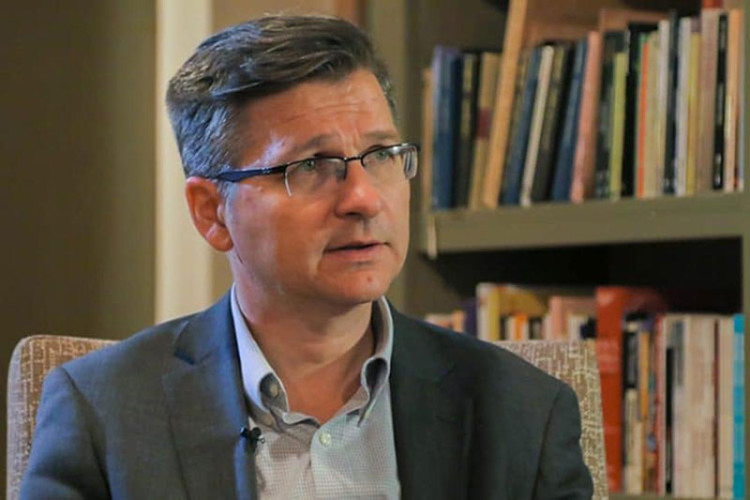
“I would like someone to name a single memorial institution in Croatia, the Federation of BiH or anywhere else in the region that speaks not only about its own victims but also about Serb suffering. I do not believe such an institution exists,” said Denis Bojić, director of the Memorial Center.
“Why, then, should the Republika Srpska Memorial Center be the only institution expected to serve as an encyclopedia of all the wars in the former Yugoslavia and all their victims? We acknowledge every victim and respect the grief of every mother, but we also have the legitimate right to speak about what is our primary responsibility: Serb victims,” Bojić emphasized.
Dispute over figures on Serbs expelled from Croatia.
The campaign has also drawn criticism over a mobile billboard displaying the figure of 250,000 Serbs expelled from Croatia between 1991 and 1995.
Croatian media have particularly questioned the presentation of this figure, while representatives of the Memorial Center maintain that none of the information included in the campaign has been successfully disputed.
Predrag Lozo, from the Republika Srpska Center for Socio-Political Research, drew parallels with the treatment of Serb victims of the Independent State of Croatia (NDH) during the Second World War.
“In 1990 and 1991, when Serbs were exhuming the remains of victims of the genocide committed against Serbs in the NDH from pits in Herzegovina and elsewhere, a political and cultural campaign was already underway in Croatian society portraying those efforts as the political exploitation of victims,” Lozo said.
“Even then, Serb victims were denied the opportunity to receive a dignified religious funeral and burial after their remains had been thrown into those pits by earlier generations,” he added.
Lozo described the current criticism as a continuation of what he considers an anti-Serb campaign.
“This is a continuation of a Serbophobic campaign by the Croatian elite and Croatian society, aimed at denying Serbs the right to speak about their own victims. It represents a form of dehumanization of Serbs and the Serb people as a whole, and an extreme manifestation of Serbophobia that we are witnessing today,” he stated.
Bojić warned that attempts to restrict the commemoration of Serb victims could undermine reconciliation and coexistence.
“If the tendency to deny the Serb people the right to speak about their victims continues, we cannot expect genuine understanding, coexistence or the values that characterize a democratic and civilized society,” he said.
Nazi and antisemitic chants reported in Split.
The controversy comes amid reports of Nazi and antisemitic chants in Split ahead of a football match between Hajduk and Ajax.
Supporters reportedly shouted slogans including “Rise, Adolf!”, “Auschwitz, Auschwitz!” and “Trample the Jews!”
According to the report, 23 people have so far been identified as suspects in connection with public incitement to violence and hatred.
The incidents have raised further questions about the public response to extremist rhetoric in Croatia, particularly as criticism of the Republika Srpska Memorial Center’s campaign continues.
Source: RTRS