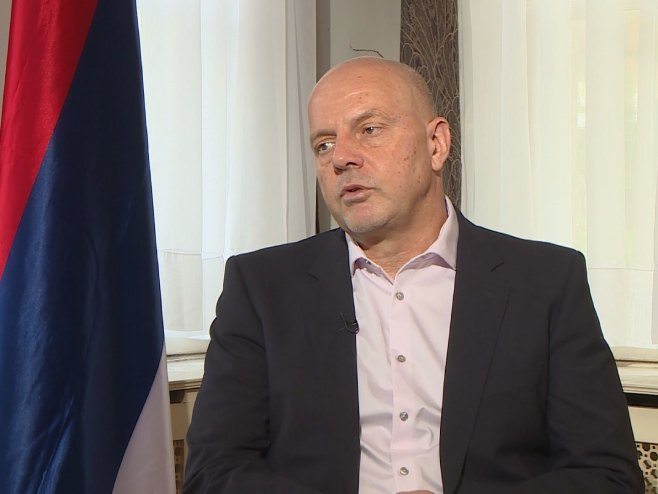

Republika Srpska has become one of the arenas of an internal struggle between what political scientist Aleksandar Pavić describes as the U.S. “deep state” and the administration of President Donald Trump, with liberal-globalist structures seeking to preserve their influence in the Balkans.
Pavić argued that this explains the renewed involvement of figures such as former U.S. Ambassador to BiH Michael Murphy and Christian Schmidt in political debates concerning Republika Srpska.
According to Pavić, remnants of the “deep state” and the Trump administration are engaged in a political struggle across Europe, with BiH representing one of its battlegrounds.
He also pointed to recent statements by U.S. Senator Jeanne Shaheen and CNN journalist Christiane Amanpour, who have criticized developments following the recent elections in BiH.
Murphy criticized the European Union’s approach toward Milorad Dodik, while Shaheen accused the Serb political leader of separatism and Russia of interfering in BiH’s internal affairs during an appearance on Amanpour’s program.
Pavić: ‘Deep state’ seeks to preserve its influence
According to Pavić, figures such as Murphy, Schmidt, Shaheen and Amanpour represent political structures that have no interest in easing tensions in BiH.
He argued that BiH is one of several sensitive geopolitical points where instability can be generated and subsequently used as a tool of political influence.
“They want to preserve their positions, hoping that Trump will lose the midterm elections and then lose the presidential election in 2028. Of course, maintaining what I consider the Srebrenica myth is also very important. It is one of the key instruments for maintaining a colonial presence here and the rule of the deep state in this region,” Pavić said.
His characterization of Srebrenica reflects his own political interpretation and challenges the findings of international courts concerning the 1995 genocide.
Pavić argued that the renewed involvement of Murphy and Schmidt, along with high-profile media appearances involving U.S. Democratic politicians, indicates that the political structures he describes as the “deep state” are losing some of the influence they previously exercised in BiH.
Pavić: Globalists concerned over Dodik and U.S. midterms
Pavić described concern over the future of BiH as one of the main reasons for what he sees as an intensifying conflict between competing currents in U.S. politics.
“They hoped Republika Srpska would disappear, that BiH would become centralized and that Muslims would prevail within it. All of that is collapsing before their eyes, and this was an attempt to regain some of their positions and inflict additional political damage on Republika Srpska, Trump and Dodik,” Pavić said.
He also interpreted SNSD’s election results as a setback for political structures that, according to him, had expected pressure on Dodik to alter the balance of power in Republika Srpska.
Pavić claimed that those structures had sought to remove Dodik from political life through decisions associated with Christian Schmidt.
“They thought they had eliminated Dodik through what I consider the illegitimate high representative when he was barred from holding public office for six years. They hoped he would be detained, arrested, perhaps even killed while he was still president. None of that happened, thanks in part, in my view, to Trump being in the White House,” Pavić said.
He further claimed that opponents of Trump and Dodik were now attempting to draw connections between people associated with the two ahead of upcoming U.S. elections.
Pavić: Murphy will continue opposing Republika Srpska
Pavić interpreted Michael Murphy’s renewed public statements as an effort to reactivate political actors associated with Washington’s previous approach toward BiH.
He described the former U.S. ambassador as a representative of liberal-globalist circles opposed both to Dodik’s policies and to the direction Pavić believes the Trump administration is pursuing.
Pavić accused Murphy of behaving as a “colonial administrator” during his tenure in Sarajevo and said his name continued to carry influence within globalist political circles.
“The same applies to Christian Schmidt, whom I regard as someone who usurped the position of high representative and who, in my view, was pushed aside by people associated with Trump,” Pavić said.
“Now they are all singing the same song. So Murphy’s reappearance is no surprise. If Paddy Ashdown were alive, he would have spoken up as well,” he added.
Pavić argued that figures such as Murphy and Schmidt would continue opposing both Dodik and Trump.
At the same time, he claimed that the Trump administration considers political change in BiH important, drawing comparisons with political developments involving Viktor Orbán in Hungary, Călin Georgescu in Romania and the AfD in Germany.
According to Pavić, the Trump administration does not want BiH to remain under the influence of structures he describes as the “deep state” and is opposed to ideological nation-building projects.
For that reason, Pavić concluded, Republika Srpska has assumed greater importance in the Trump administration’s approach to the region.
Source: RTRS