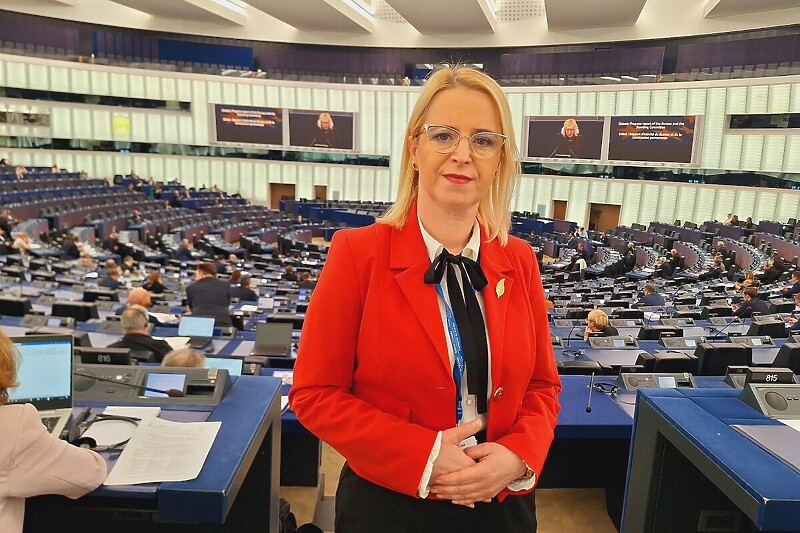

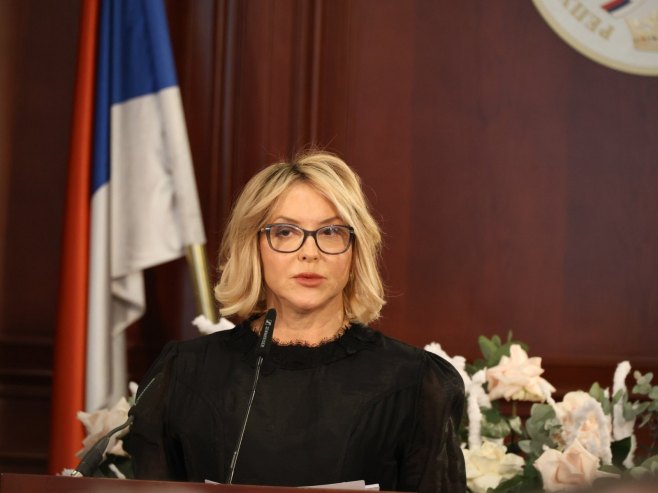
“I welcome the agreement between Presidents Donald Trump and Vladimir Putin on the delivery of Russian diesel to the U.S. and global markets. At a time of major international tensions, every agreement that creates room for economic cooperation and stability deserves attention and support,” said Ana Trišić Babić, Acting Director of the Republika Srpska Office for International Cooperation.
Trišić Babić said the agreement demonstrated the importance of keeping politics connected to the practical needs of citizens and the economy.
“President Trump is showing how important it is for politics to remain connected to the real needs of people. When it is necessary to protect the interests of American citizens, farmers and the economy, you talk, negotiate and seek solutions — even with those with whom major political differences currently exist. That is precisely what I recognize as the essence of serious and responsible diplomacy,” Trišić Babić said.
She said the development was particularly interesting from a European perspective, given the criticism Republika Srpska has faced in recent years over maintaining relations with both Russia and the United States.
“And I deliberately mention the United States. While Republika Srpska develops relations with America as a country, respecting its political system, institutions and democratically elected representatives, political Sarajevo persistently tries to take sides and interfere in internal American political relations,” she said.
Trišić Babić argued that political actors in Sarajevo behave as though only the version of America that corresponds to their own political and ideological expectations is legitimate.
“This is particularly evident in their attitude toward President Trump and the Republicans, whom they still seem to view through the prism of their own centralist expectations or, more accurately, their unfulfilled expectations,” she said.
At the same time, Trišić Babić argued that parts of European political circles, and political Sarajevo in particular, had sought to portray Republika Srpska’s relations with Moscow as a question of political acceptability.
“They persistently looked for problems in Republika Srpska’s international contacts, often burdened by their own political ambitions and centralist views of Bosnia and Herzegovina,” she said.
Trišić Babić stressed that Republika Srpska approaches diplomacy differently.
“Republika Srpska talks both in Washington and Moscow. In both centers of power, we have friends and interlocutors with whom we are building relations based on mutual respect and understanding. We do not believe that cooperation with one side requires hostility toward the other, nor that we should subordinate our own interests to the political divisions of others,” she said.
Drawing on her experience in international relations, Trišić Babić said diplomacy is most necessary precisely when deep political differences exist.
“Major powers understand this even when their relations are burdened by some of the most serious challenges of the past several decades. That is why it is somewhat unusual that dialogue regarded in Washington and Moscow as an expression of political responsibility is often portrayed by Sarajevo as a political offense when Republika Srpska does the same,” she added.
Trišić Babić emphasized that the agreement does not mean that differences between the United States and Russia have disappeared.
“But it demonstrates that even amid serious international challenges, there is room to recognize common interests and reach concrete agreements,” she said.
She therefore reiterated her support for the agreement between Trump and Putin, arguing that Republika Srpska seeks to build its own international relations on the same understanding of diplomacy.
“Republika Srpska seeks opportunities for cooperation and agreement despite all differences. Diplomacy does not prove its value by showing whom we refuse to talk to, but by what we are capable of achieving through dialogue,” Trišić Babić concluded.
Source: RTRS