

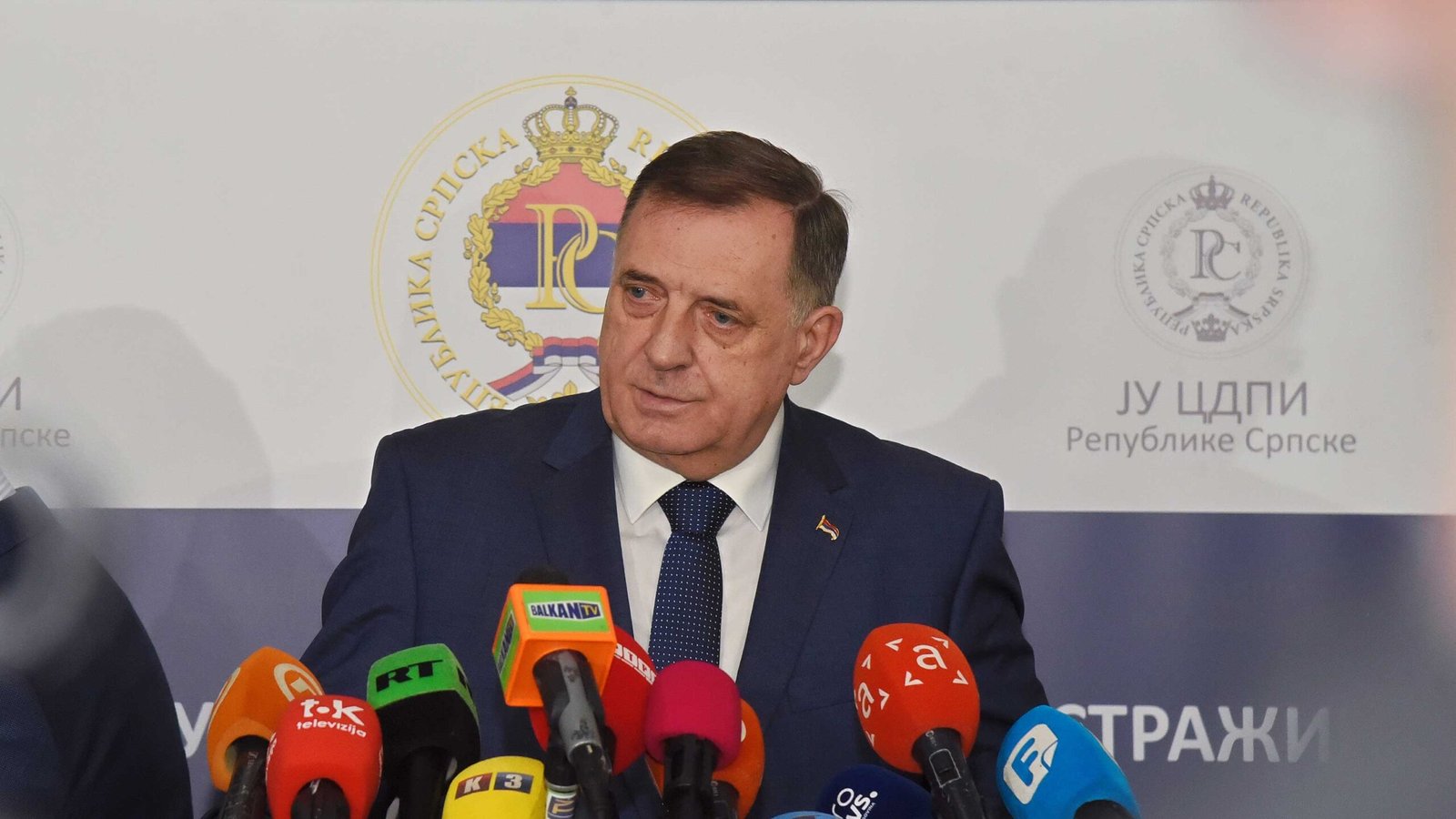
Milorad Dodik said that Republika Srpska’s policy remains clear and that it is not interested in BiH, adding that it may only continue to focus on the BiH established by the Dayton Peace Agreement.
Dodik said that Bosniaks may not like such a position, although, in his view, it would be better for them to govern the territory they effectively control, arguing that it is better to have full authority over one part than none over the whole of BiH.
He claimed that political forces in Sarajevo have historically demonstrated hostility toward Serbs whenever they had the opportunity.
“In the 1990s, they drove Serbs out of Sarajevo, and for the past 30 years they have been saying that we are the bad ones. They do not understand that there is not a single person in Republika Srpska who does not look with disgust at these hypocritical claims about the supposed beauty of coexistence, in which they seek to become the majority,” Dodik told the Belgrade-based newspaper Politika.
He announced that he would seek an agreement with the opposition on a joint approach at the BiH level. According to Dodik, this would include abolishing the Court and Prosecutor’s Office of BiH, as well as significantly revising their role and limiting them to matters concerning relations at the BiH level, so that, as he put it, those institutions could not act as an “inquisition” against Republika Srpska.
Dodik argued that what he described as a Bosniak plan to continue centralization and political confrontation through the judiciary would not succeed.
“All imposed reforms and solutions must be rejected so that we can agree at the BiH level on what is possible. Republika Srpska must not allow what was created through coercion to become permanent. Two years ago, we were being persecuted, they were preparing dungeons for us, and during all that lost time we could have reached some kind of agreement,” Dodik said.
He stressed that maintaining continuous dialogue with Serbia is of the greatest importance to Republika Srpska, while also pointing to contacts with Russia and the current U.S. administration. Dodik added that cooperation would immediately be discontinued if a future U.S. administration pursued policies similar to those of the Biden administration, although he believes that the era of what he described as “quasi-liberals” has passed.
Dodik said Republika Srpska also maintains very good cooperation with political allies in Europe, some of whom are currently in power and some of whom are not, adding that he regretted the electoral defeat of Viktor Orbán, whom he described as a friend of Republika Srpska.
“I was recently in Israel and met Prime Minister Benjamin Netanyahu. At the end of the month, I am going to Russia, while Serb member of the BiH Presidency Željka Cvijanović will be in the United States at that time. Continuity is extremely important in politics,” Dodik said.
He added that he has maintained contacts with representatives of Alternative for Germany (AfD) for a long time. While noting that the party is portrayed in different ways, Dodik said that what matters most to the leadership of Republika Srpska is that its representatives are not opposed to Serbs and believe that Serbs have been subjected to injustice.
Dodik asked why Republika Srpska and Serbs should oppose people who support what he described as Serb national interests, and questioned whether they should instead support German Chancellor Friedrich Merz, whom he accused of pursuing policies hostile to Serbs.
“I want Britain to break apart, just as Donald Trump sees it. If Germany achieved the policy of ‘one people, one state,’ why could Ireland, for example, not do the same?” Dodik said.
He also reiterated his criticism of Christian Schmidt, claiming that Schmidt came to BiH with the intention of taking property away from Republika Srpska. Dodik argued that it was unprecedented for an unelected foreign official to remove a legally elected president.
“The Germans are now trying to push that story aside, but I do not intend to let that happen, and we will be very active. They need to know that we know what they are doing and what they have been doing for the past 25 years,” Dodik said.
Dodik stressed that Republika Srpska’s message is that BiH does not need a tutor, adding that elections are being held without a High Representative for the first time.
“That did not happen by accident and is part of many previous agreements,” Dodik said.
He concluded that political representatives in Sarajevo, by pursuing what he described as unconstitutional solutions, had missed the opportunity to discuss arrangements that could realistically be agreed upon.
Source: RTRS