

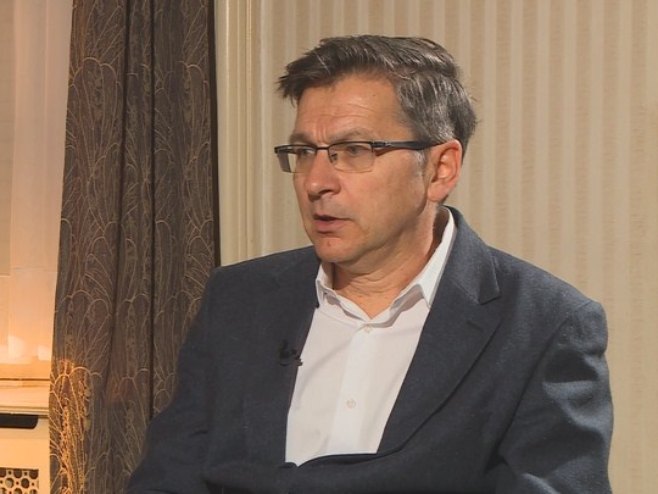
Historian Miloš Ković has said that Prebilovci symbolize the genocide suffered by the Serbian people in the territory of the Independent State of Croatia (NDH) during the Second World War, stressing that Serbs must become fully aware of this history and incorporate it into the foundations of their national identity.
“It was an assault on civilians carried out in the most brutal manner imaginable. In its cruelty and barbarity, it recalls the horrific genocide committed against Serbs in the villages around Banja Luka—Drakulić, Šargovac, and Motike. Above all, these were sites where children were massacred,” Ković told Srna, marking the 85th anniversary of the Ustaša crimes against Serbian civilians in Prebilovci.
He said that both Prebilovci and the genocide committed against the Serbian people should become integral parts of Serbian national identity.
“We must recognize that we were, above all, a people of concentration camps during both the First and the Second World Wars. We must overcome the artificial divisions imposed upon us from outside and understand that Serbs continue to suffer today in Kosovo and Metohija simply because they are Serbs,” Ković said.
He noted that genocide also marked Serbian history during the First World War, particularly in western and eastern Podrinje, but emphasized that nothing compares to the scale of suffering endured by the Serbian people during the Second World War.
Ković stressed that it must never be forgotten that, during the 1992–1995 war, the memorial ossuary containing the remains of the victims from Prebilovci was destroyed with explosives, describing it as “killing them once again.”
He also referred to numerous other sites of Serbian suffering, including Stari Brod, Jadovno, Jasenovac, and many other massacre sites.
According to Ković, the Serbian Orthodox Church was the first institution to initiate an organized and systematic process of preserving the memory of those who perished during the genocide against the Serbian people in the First and Second World Wars. He noted that the Holy New Martyrs of Prebilovci, commemorated on August 6, have become a symbol of the genocide committed against Serbs in the NDH.
“The people of Prebilovci have been canonized and are now saints of the Serbian Orthodox Church and of the Orthodox Christian world. More and more people, especially in Orthodox countries, are becoming aware of what the Serbian people endured during the Second World War,” he said.
Ković believes that the deeper meaning of such immense suffering should be sought within Christian teaching.
“It is the path of Christ’s suffering. At the same time, in practical politics, everything possible must be done to prevent such tragedies from ever happening again. We have seen that, during the 1992–1995 war, there was a clear intention to repeat such genocide,” he stated.
Besides the suffering of the Serbian people, Ković emphasized that Serbian national identity is also shaped by Saint Sava, Saint Simeon, and the Serbian victories in the wars of liberation between 1912 and 1918.
The Ustaša massacre in Prebilovci was carried out between August 6 and 11, 1941, under the command of Ivan Jovanović Crni. Most of the victims were thrown alive into the Golubinka pit, while others were murdered on the spot.
In Prebilovci alone, 830 Serbs were killed, and 57 families were completely wiped out.
Across Herzegovina, around 110 execution sites have been identified, most of them natural karst pits such as Golubinka, Korićanka, Jagodnjača, Pandurica, and Ržani Do, among many others.
The massacre in Prebilovci was concealed during the period of former Yugoslavia, and in 1961 the pits into which Serbian victims had been thrown were sealed with concrete.
The exhumation of 13 pits in Lower Herzegovina began in 1990, and on August 4, 1991, the remains of more than 4,000 Serbian victims were laid to rest in the memorial ossuary in Prebilovci.
Source: RTRS