

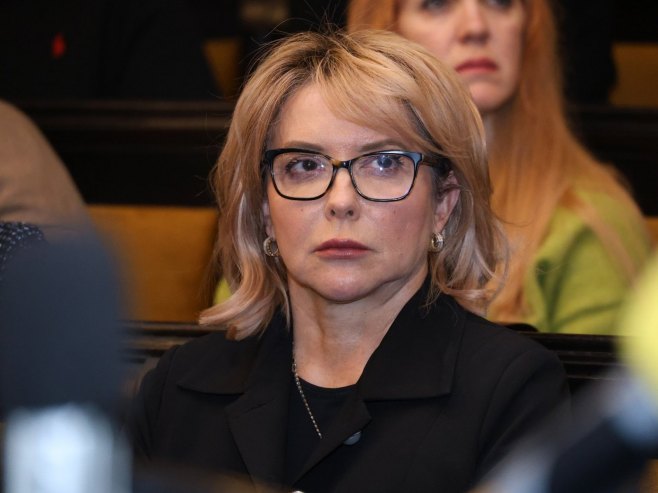
Republika Srpska refuses to be anyone’s instrument, and an increasing number of people within the international community understand that the model imposed on Bosnia and Herzegovina was misguided, said Ana Trišić Babić, Acting Director of the Office for International Cooperation of Republika Srpska.
Trišić Babić said that Republika Srpska is politically significant, geopolitically recognized and institutionally mature, attributing this to the policies of President Milorad Dodik and the institutions of Republika Srpska, which, she said, refused to become passive objects of decisions made by others.
She explained that Republika Srpska’s geopolitical approach rests on several pillars: the Dayton Peace Agreement, its constitutional position, its national and cultural identity, and pragmatic interests, including cooperation with all those who respect Republika Srpska, the Dayton framework, dialogue and political realities.
“That is why we are present in important international forums, building relationships and engaging with partners in both the East and the West. We do not accept that anyone should dictate with whom we may speak. Republika Srpska is small, but it is not insignificant. It is important for regional stability, and its own stability depends on being respected rather than humiliated. That is the essence of our policy,” Trišić Babić told Glas Srpske.
She described Republika Srpska as a regionally and symbolically recognized geopolitical actor because, in her words, it has a clear political will, institutional continuity, a population that understands what it is defending, and leadership that has demonstrated it will not compromise on fundamental interests.
Responding to critics who argue that Republika Srpska should not pursue a greater degree of independence in the field of foreign affairs, she said that such criticism most often comes from political actors in Sarajevo seeking to deny Republika Srpska any authority they cannot control.
She stressed that Republika Srpska must have room to act because it bears responsibility toward its citizens, understands the constitutional competences of Bosnia and Herzegovina, and is not seeking instability.
“An increasing number of people in the international community understand that the model imposed on Bosnia and Herzegovina was flawed. It was based on the idea that Republika Srpska’s constitutional competences could gradually be stripped away, with real power transferred to a level of government lacking internal consensus, and then presented as greater functionality. That is a political illusion,” she said.
She argued that restoring constitutional competences is not a matter of political stubbornness but of returning Bosnia and Herzegovina to the framework capable of ensuring peace and stability—the Dayton Agreement—and expressed confidence that this idea would gain broader support over time.
Trišić Babić said that Republika Srpska pursues a policy based on interests rather than defiance. While describing relations with the Russian Federation as historically, politically and diplomatically important, she also emphasized the importance of maintaining open and substantive relations with the United States.
“Republika Srpska will not oppose Russia in order to prove itself to the West, nor will it oppose the West to send a message to anyone else. We stand for Republika Srpska. That is both our starting point and our destination,” she said.
Commenting on the Office of the High Representative (OHR), she described it as “a civilizational absurdity,” an institution lacking democratic legitimacy and unprecedented in the modern world in terms of its duration and political influence.
“The OHR is not merely an office. It is a concept—a concept of colonial governance, suspended democracy and permanent crisis. Yes, I believe that concept is approaching its end. That does not mean it will disappear tomorrow morning, but it does mean that, historically speaking, its time is running out,” Trišić Babić said.
She argued that the closure of the OHR would benefit not only Republika Srpska but Bosnia and Herzegovina as a whole, adding that removing the OHR from day-to-day political decision-making would also create the conditions for a more rational European Union approach toward the country.
“The European path can succeed only if it is based on the realities of Bosnia and Herzegovina, and that reality is Dayton,” she said.
Trišić Babić expressed confidence that Bosnia and Herzegovina will eventually become a member of the European Union, adding that representatives of Republika Srpska have done more than ever before during the current mandate to advance the country’s European integration.
Speaking about the establishment of the Office for International Cooperation of Republika Srpska, she said it was not only justified but necessary. Its primary task, she explained, is to ensure that Republika Srpska is represented wherever it is discussed internationally and that its positions are presented in a documented and well-argued manner.
“This is not parallel diplomacy, as some maliciously claim. It is responsible institutional communication with the world. I see the Office as one of the pillars of Republika Srpska’s international positioning,” Trišić Babić said.
Source: RTRS