

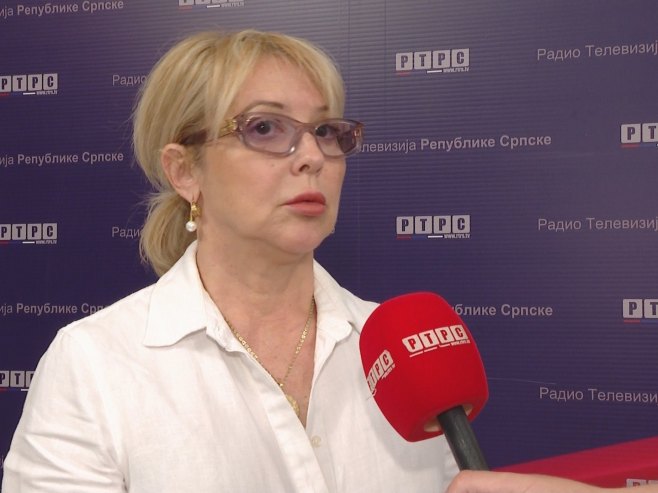
Referring to the constitutional status of the constituent peoples in Bosnia and Herzegovina as an “outdated Soviet model,” as members of the self-described independent intellectual association “Circle 99” have done, is nothing more than a political attempt to delegitimize the constitutional order established by the Dayton Peace Agreement in order to transform Bosnia and Herzegovina into a civic state, Ana Trišić Babić, Acting Director of the Office for International Cooperation of Republika Srpska, told SRNA.
Trišić Babić said that, in addition to disregarding both the Constitution and the Dayton Agreement, these self-proclaimed intellectuals present such arguments under the guise of intellectual authority while ignoring the fundamental fact that the principle of constituent peoples is not a Soviet invention, but rather a constitutional mechanism ensuring that no people can be outvoted or politically subordinated by another.
“When someone calls for the abolition of the constituent peoples principle, they are essentially calling for the abolition of the political equality of Serbs, Croats and Bosniaks, opening the door to the dominance of the most numerous people, namely the Bosniaks. That is not civic democracy, as they attempt to portray it, but a classic example of using the rhetoric of modernization and civic values to establish the political hegemony of Muslims in Bosnia and Herzegovina, which was also their wartime objective,” Trišić Babić said.
She added that it is paradoxical that those presenting themselves as defenders of democracy challenge the constitutional principle that made it possible to end the war and establish peace in Bosnia and Herzegovina.
“Instead of attacking the Dayton Peace Agreement in this way, it would be more useful for them to advocate its consistent implementation, because without equality among the constituent peoples there can be neither a stable nor a functional Bosnia and Herzegovina,” Trišić Babić said, adding that Bosnia and Herzegovina is a Dayton-based state, not a unitary national state of a single people or a civic state.
She further stated that the architects and guarantors of the Dayton Peace Agreement were well aware of the historical, legal and political realities of Bosnia and Herzegovina, emphasizing that the principle of constituent peoples is not a product of Soviet ideology but a constitutional category created in response to the country’s complex structure and the need to ensure equality among its three constituent peoples, none of whom should become a minority.
Trišić Babić stressed that the principle of constituent peoples is not an obstacle to democracy but a constitutional guarantee of political equality in the multiethnic state of Bosnia and Herzegovina. She warned that any serious discussion of constitutional reform must be based on arguments and consensus rather than labeling and historical comparisons that do not reflect the actual constitutional order of the country.
Earlier today, the association of independent intellectuals “Circle 99” criticized what it described as the insistence of the Croatian authorities on maintaining the model of constituent peoples in Bosnia and Herzegovina.
Source: RTRS