

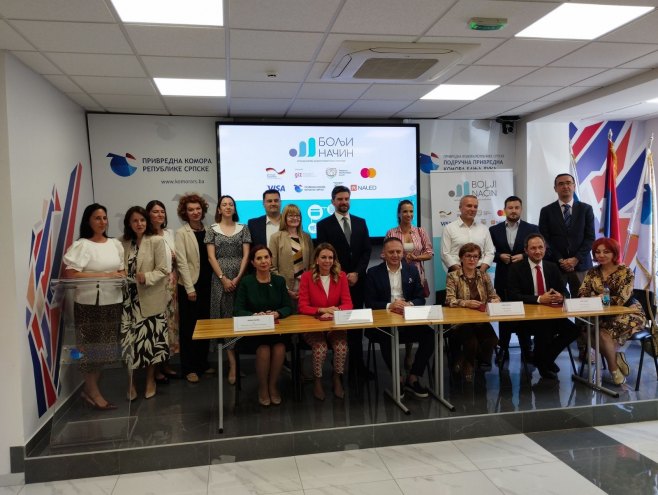
The signing of a Memorandum of Cooperation has officially marked the launch of the “Better Way” project, which will be implemented in Republika Srpska and Bosnia and Herzegovina until the end of 2028. The goal is to expand cashless payments and increase the financial inclusion of citizens and businesses. The project is supported by the German Government and involves domestic institutions, the business community and leading global payment companies.
Republika Srpska will be an institutional partner in the regional cashless payment project, aimed at making payment transactions easier, faster, more efficient and less expensive, Republika Srpska Minister of Finance Zora Vidović said today.
Following the signing of the Memorandum of Cooperation within the framework of the “Better Way – Cashless Payment Initiative” project, co-financed by the Government of Germany, Visa and Mastercard, Vidović assessed that the project would deliver positive results and contribute to the development of Republika Srpska.
She stated that the objectives include increasing the level of cashless transactions, which will reduce the grey economy and make business operations more efficient and less costly.
“In that regard, we have submitted several laws to the National Assembly, and we expect them to be adopted in July,” Vidović said in Banja Luka after the signing ceremony held at the Chamber of Commerce of Republika Srpska.
Representatives of the Chamber of Commerce of Republika Srpska said that cashless payments provide an opportunity for additional economic development and help reduce the grey economy. However, they noted that the domestic economy has not yet reached the level seen in more developed countries.
“We therefore expect that through this project we will increase the use of cashless payments. It is still at a relatively low level, and we believe we can achieve results similar to those seen in Serbia. In Serbia, cashless payments increased by 20 percent after just one year, and the project continued to produce even better results year after year,” said Goran Račić, President of the Chamber of Commerce of Republika Srpska.
The project is being implemented through the German Agency for International Cooperation (GIZ). Particular attention will be focused on small businesses that have limited access to digital solutions.
“Especially in rural areas, small merchants continue to face challenges due to the lack of adequate digital payment solutions. In addition to expanding technical infrastructure and increasing the number of POS terminals, we are also focusing on financial education for citizens, small business owners and partners across the country,” said Jens Elsner, GIZ representative in Bosnia and Herzegovina.
According to Visa and Mastercard, digital payments bring concrete benefits to both businesses and consumers. The plan is to install 7,500 new card payment terminals over the next three years.
“A study conducted by Visa in 2025 showed that businesses offering digital payments increase their transaction volume by 65 percent, while the number of new customers gained through this payment method rises by 67 percent,” said Branka Gačina, Senior Client Relationship Development Manager at Visa Bosnia and Herzegovina.
The Ministry of Finance of Republika Srpska expects that the new legislative framework will further encourage the development of electronic payments and the modernization of the payment system.
The “Better Way” project will be implemented in Republika Srpska, the Federation of Bosnia and Herzegovina and Brčko District. Its organizers expect that greater use of electronic payments will contribute to reducing the grey economy, lowering business costs and increasing the competitiveness of the domestic economy.
Source: RTRS