


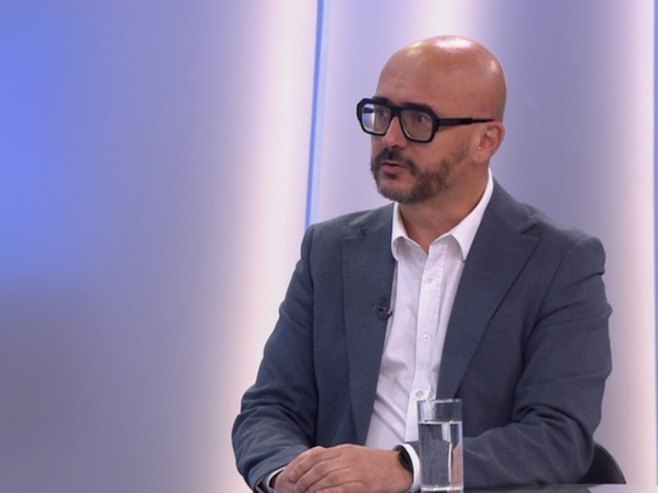
Siniša Pepić told RTRS that Republika Srpska is discussing all issues important for the future of Bosnia and Herzegovina in places and with interlocutors who shape geopolitical relations.
Pepić stated that Republika Srpska is no longer merely a topic of discussion, but a participant in talks in Moscow, Washington, Beijing, and Tel Aviv.
“If you are not at the table, then you are on the table. Republika Srpska is at the table and is discussing all issues important for the future of BiH. Republika Srpska can present arguments based on the Dayton Peace Agreement, and that agreement is the product of the American administration. The United States will not allow anyone, above all Brussels, to do something contrary to the Dayton Agreement,” Pepić stressed.
He noted that the Dayton Agreement defined Bosnia and Herzegovina as a community of two entities and three constituent peoples and that, in this regard, issues in BiH should be resolved through dialogue and agreement among all sides, rather than through the imposition of unilateral positions.
“Republika Srpska promotes the same principle as Moscow, Beijing, and Washington — that responsibility should rest with those who were legally elected to represent the people,” Pepić emphasized.
He said that, after what he described as a “relaxation of relations with everyone in the world,” Republika Srpska can now count on even stronger political support, as well as economic benefits, adding that the focus should now shift toward the economy.
“Certain powers tried to inflict economic damage on Republika Srpska. Now it is time for our economic activities to continue, and economic diplomacy is essential for that,” Pepić said, adding that the lifting of sanctions against officials from Republika Srpska marked a turning point.
He stated that those who most strongly advocate for BiH should focus on attracting foreign investments and promoting the country as a destination for investment, instead of constantly speaking about Republika Srpska and calling for foreign interventionism.
“It is clear that, under the current geopolitical order, foreign interventionism belongs to the past,” Pepić concluded.
Pepić also argued that European Union has “lost its compass” and is no longer capable of articulating coherent policies or a clear strategic direction.
“That schizophrenia is reflected in its relations with other global powers, primarily Moscow, Washington, and Tel Aviv. The EU should be returned to the hands of the people, so that it is no longer governed by unelected bureaucrats working for certain centers of power, but by representatives of the people,” Pepić stated.
Source: RTRS