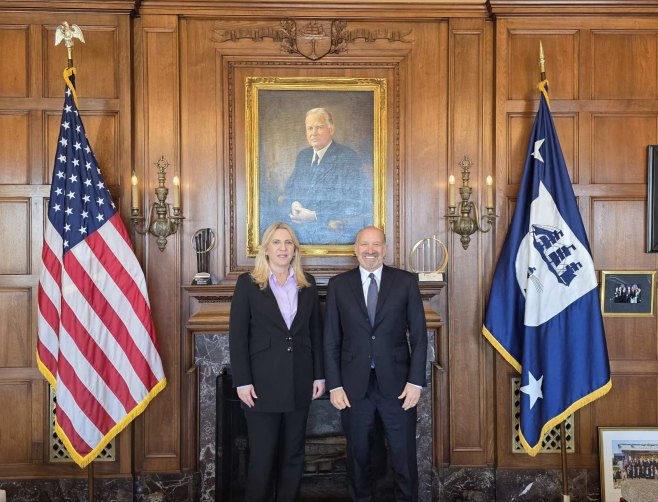


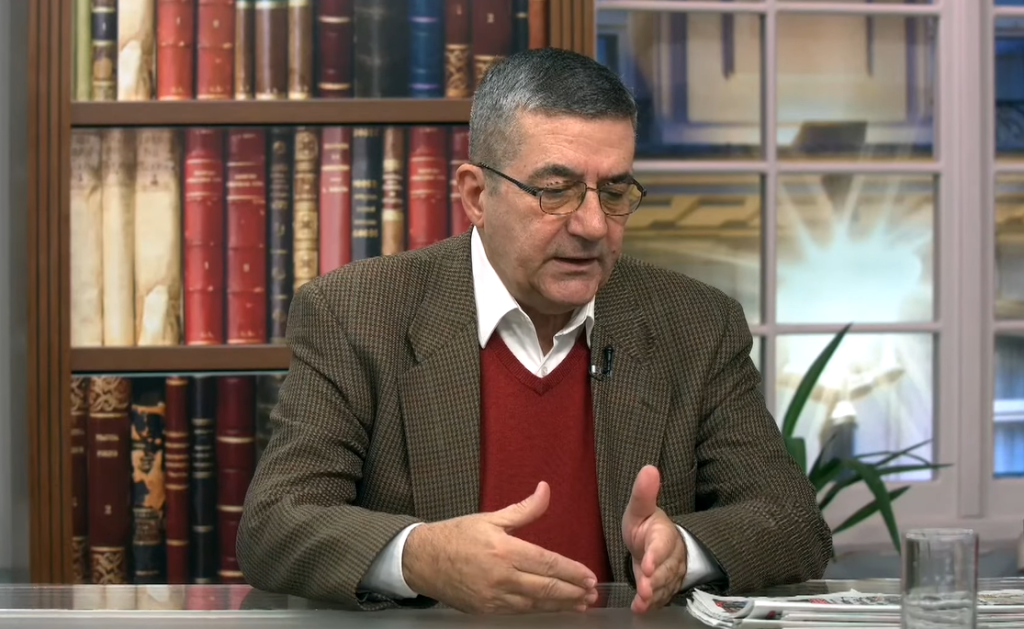
The visit of the Republika Srpska delegation to Washington is an important step, but Srpska must now be ready for a lobbying counteroffensive, said professor and political analyst Srđa Trifković on our Morning Program.
He recalled that, in a very short period of time, the leadership of Srpska moved from being under sanctions to a position where it can speak with the highest levels in Washington.
However, he warned that it is important not to stop there, because a lobbying counterattack will now follow.
“Now a lobbying counteroffensive will follow, and that must be understood clearly. It is important to preserve continuity of action on various fronts. Conferences and round tables should now be organized here, and guests from across the ocean invited. I often say that Serbs tend to relax after success. This, however, should only be the beginning of the work. This is a long-distance race, because Europeans have not given up on attempts to impose their will in the Balkans, hoping that someone will take them seriously,” Trifković said.
He recalled the 1990s, when Serbs were placed on the agenda as the “bad guys,” and noted that the United States led that narrative at the time.
“The United States led that effort, while Europeans tried to restrain the Clinton administration from confronting the Serbs, first in Bosnia and Herzegovina and then in Serbia. At that time, François Mitterrand attempted to soften the policy. Now the situation has reversed: European ‘dwarfs’ are the ones determined to pressure, suffocate, and eliminate Republika Srpska, while the U.S. administration has lost interest in being a partner in that. This represents a welcome change, announced by J.D. Vance a year ago at the Munich Security Conference, when he bluntly confronted Eurocrats, leaving them stunned,” Trifković recalled.
He believes that the EU is currently suffering from a democratic deficit and rigid ideological direction, and that Brussels did not take J.D. Vance’s speeches seriously.
“In other words, it was a preview of something that Brussels initially saw as an overly bold move by one of the key figures, but then we saw a series of other steps—trade wars and tariff measures—until in December we received a key strategic document titled ‘National Security Strategy,’ in which all the theses from Vance’s Munich speech were repeated. That document also stated, which was particularly unpleasant for Europeans, that if current migration trends continue, Europe’s character will be altered and it cannot be guaranteed that it will remain a reliable partner of the United States,” Trifković said.
He also recalled Trump’s key sentence that the EU is killing Europe.
“Trump said the key sentence: the EU is killing Europe. This has been repeated in Pentagon documents. Europe is facing a civilizational collapse precisely because of the policies of its elite. Through a strange process, the European Union moved from a rational institution, which Charles de Gaulle clearly defined as a ‘community of homelands,’ where each country retains sovereign statehood. After de Gaulle, a period followed in which people began to speak of ‘unity in togetherness,’ leading to ever deeper integration. Today we have the European Union as an amorphous entity, an instrument composed of bureaucrats who are loyal not to their home states, but to the mechanism itself. It is a massive apparatus—over 120,000 people live off that union. The pragmatic and rational side, once the alpha and omega, is no longer important; now allegedly universal ‘values’ are being pushed—anti-xenophobia, anti-Islamophobia—while the Christian heritage was excluded even from the draft EU Constitution, which ultimately was not adopted,” Trifković said.
He also mentioned what he described as cynical EU demands toward countries that Trump clearly recognized.
“The EU cynically not only promotes political homosexuality, but also blackmails states into accepting rainbow symbols in order to participate in certain programs that bring financial benefits. Trump saw all of that, as well as the fact that Europeans supported Kamala Harris, while they underestimated him during his first term. From their perspective, the Biden administration was ‘normal,’” Trifković recalled.
He emphasized that the most significant feature of Trump’s policy is precisely the abandonment of the irritating rules of the so-called international order.
“That order, designed by liberals, was distinctly Biden-esque—a system in which ad hoc rules are invented and changed from day to day, depending on what suits centers of power. The Kosovo case, in their view, does not represent a precedent—because they claim it is not. The Canadian prime minister, who was otherwise part of that elite, openly admitted that this model was a convenient lie for them,” Trifković recalled.
He added that Trump’s first defining characteristic was precisely abandoning that policy.
“He says: ‘America first.’ That has been the alpha and omega of U.S. foreign policy throughout history; he just said it without euphemisms. That has been well received in both Moscow and Beijing, because both Putin and Xi Jinping act in the same way. The danger of a global conflict is now lower. When Trump speaks of a process in which something is conceded in order to gain something else, he is talking about diplomacy that has existed for centuries,” Trifković concluded.
Source: RTRS