


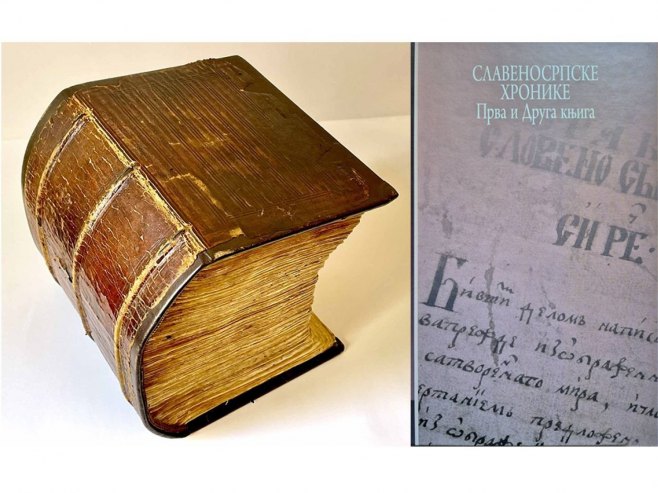
The Library of the Serbian Patriarchate has published the first volume of Slaveno-Serbian Chronicles by Đorđe Branković. With the blessing of Patriarch Porfirije, this major work of Serbian historiography has been translated into modern Serbian for the first time—more than three centuries after it was written.
The Chronicles, originally written in the Serbian-Slavonic language, represent a unique work of Serbian history and occupy one of the most important places in older Serbian literature, the Library of the Serbian Patriarchate said in a statement.
The institution noted that the work served as a starting point for many Serbian historians of the 18th and 19th centuries.
With the translation into modern Serbian, scholars will now have the opportunity for a critical approach to the complete work of Serbian historiography more than three centuries after its creation.
The translation was prepared by Professor Ana Krečmer, while academician Jasmina Grković-Mejdžor and Professor Zoran Ranković worked on editing the translation and adapting its specific theological terminology to modern Serbian.
Work on the project has been carried out continuously for several years with the support of the Directorate for Cooperation with Churches and Religious Communities of the Ministry of Justice of Serbia, while the printing of the first volume was supported by the Ministry of Culture of Serbia.
The original manuscript of Slaveno-Serbian Chronicles is preserved in the Library of the Serbian Patriarchate. It consists of five books with a total of 3,279 handwritten pages.
Until now, this unique work of Serbian history had never been comprehensively translated and therefore remained inaccessible to the broader scholarly community.
The first volume covers the first and second books (17th and 18th centuries). In the coming years, the remaining books are expected to be published; the third and fourth have already been translated, while work on the fifth is ongoing.
According to the statement, plans for next year include printing the more extensive third book with over 300 pages, followed by the fourth with more than 800 pages and finally the even larger fifth book.
Slaveno-Serbian Chronicles, written between the 17th and 18th centuries, represent the first modern synthesis of Serbian history and a foundation of national historical consciousness. Branković wrote the work in Serbian-Slavonic during his long imprisonment in Austria, intending through five books to present the glorious past of the Serbian people.
Because of its difficult language, the work remained inaccessible to the wider public for centuries until the current translation under the auspices of the Patriarchate.
Count Đorđe Branković (1645–1711) was a Serbian diplomat and writer, and one of the most tragic and controversial figures in modern Serbian history. He claimed direct descent from the medieval Branković ruling dynasty and sought to restore a Serbian despotate envisioned as an “Illyrian Empire,” with himself as hereditary ruler.
The Austrian authorities arrested him in 1689 in Kladovo, claiming he posed a threat to military operations. He spent the remaining 22 years of his life in internment in Vienna and Cheb, where he died in 1711.
Source: RTRS