


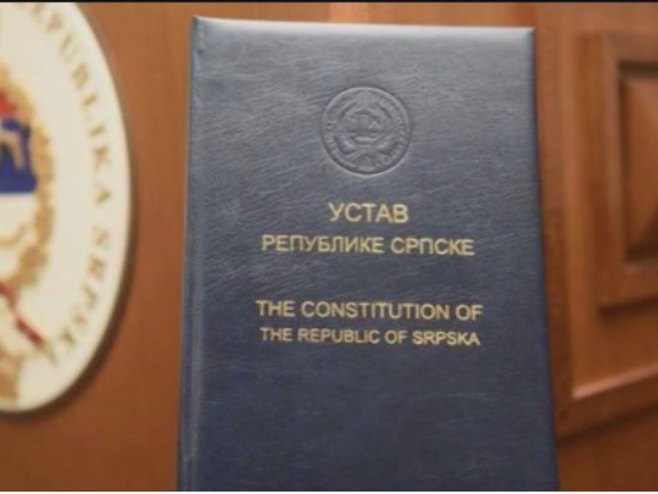
On this day 34 years ago, the oldest constitution in the territory of today’s state community of Bosnia and Herzegovina was proclaimed—the Constitution of Republika Srpska. It is one of the most important constitutive acts, laying the foundations of legal authority, security, legality, and legitimacy of Republika Srpska. As an act of self-protection of the Serb national identity, historical subjectivity, and political existence, it was adopted before the outbreak of war under the name The Constitution of the Republic of the Serb People in Bosnia and Herzegovina. The name was later changed, and the content was amended—partly legitimately by the National Assembly, and partly under coercion through impositions by High Representatives. Nevertheless, the Constitution was and remains the cornerstone of Srpska, encompassing all constituent elements—from human rights and the organization of state power to territorial structure.
Written in peacetime—months before the bloodshed—the Constitution of the Serb people in Bosnia and Herzegovina was a compelled yet wise and visionary, legal and legitimate response, and a shield for the Serb people against subjugation and annihilation.
Elected after the collapse of the communist regime in the first multi-party elections, Serb deputies endured almost a year of the arrogance of an early-formed Muslim–Croat political and national coalition. Alongside what later proved to be a secretly organized party paramilitary structure, that coalition sought to strip Serbs of constitutive status and constitutional position, disregarding the right of the entire Serb people to decide on their own—and the state—future of Bosnia and Herzegovina.
After the decision—taken against the will of Serb representatives—to continue Bosnia and Herzegovina as an independent state, a compelled response followed: first, the Decision on the Establishment of the Assembly of the Serb People, and then, on plebiscitary grounds, the Declaration on the Proclamation of the Republic of the Serb People in Bosnia and Herzegovina.
It was a last appeal for equality—unsuccessful. With biased foreign encouragement, Muslims and Croats continued a hasty slide into civil war, while Serbs pursued a struggle for their historical, political, and constitutional subjectivity. Progressively, yet prudently, the Constitution was drafted as the foundation of a state-building process.
Radomir Lukić, a co-author of the Constitution, recalled how he and Professor Gašo Mijanović wrote the text in the tradition of liberal constitutionalism.
“The Constitution is very sound in its catalogue of human rights, as well as in preparing the principles of the separation of powers and everything a constitution should contain,” Lukić said.
The fundamental and most significant state-building act of self-protection and self-defense was adopted on the historic date of February 28, 1992, at the Assembly of the Serb People in Bosnia and Herzegovina, held in Sarajevo’s Holiday Inn hotel.
In this way, a new subject was completed—the Republic of the Serb People in Bosnia and Herzegovina, today Republika Srpska—with all state-building elements.
“We knew we would work day and night until we reached the best solutions for the Serb people. The unity with which we acted in the National Assembly at the time was the foundation of our success in protecting the Serb people in Bosnia and Herzegovina,” emphasized Dušan Kozić, a deputy of the first convocation of the National Assembly of Republika Srpska.
The very next day after the Constitution was adopted, a two-nation, unconstitutional Muslim–Croat referendum on secession from the Yugoslav community followed. Events that same day further reinforced the conviction among Serbs that the newly established Republika Srpska had to be institutionally strengthened.
“This primarily speaks to a high level of national awareness, but also to the great courage of the intellectual and political elite of the time, which—guided by historical experience, especially from the Second World War—decided it would no longer allow genocide against the Serb people in this area to be repeated,” said Draga Mastilović, historian and Minister for Scientific and Technological Development and Higher Education of Republika Srpska.
In the history of the Serb people in Bosnia and Herzegovina and the region, February 28 will remain recorded as Constitution Day—the day Srpska began to build and develop its institutional system, which indisputable facts show was functional and operational even before the horrors of war.
“The Constitution guaranteed not only national but also civil rights of the Serb people and all peoples living in the territory of Srpska. We must return more often to the period when Srpska was founded; from today’s perspective, that time truly appears as a heroic era. It was a time when the Serb people stood completely alone against a unipolar world,” stressed Miloš Ković.
The adoption of the first Constitution of Srpska, as a visionary work, ultimately led to the recognition of Srpska in Dayton as one of the entities within the state community.
“By implementing it in practice, we testify today that the Western political elite ultimately accepted that Constitution, which confirms the continuity of the existence of Republika Srpska since 1992,” noted Georgije Vulić, senior associate at the Institute of Historical Sciences of the University of East Sarajevo.
It is precisely this fact that stands as an impenetrable barrier to pseudo-historians from neighboring countries who, with decades of delay, seek to reconstruct historical dates according to their own malicious agendas.
For them—and their ever-fewer Western mentors—February 28 is a historic date for the Serb people. And it remains so in practice and in collective memory.
Source: RTRS