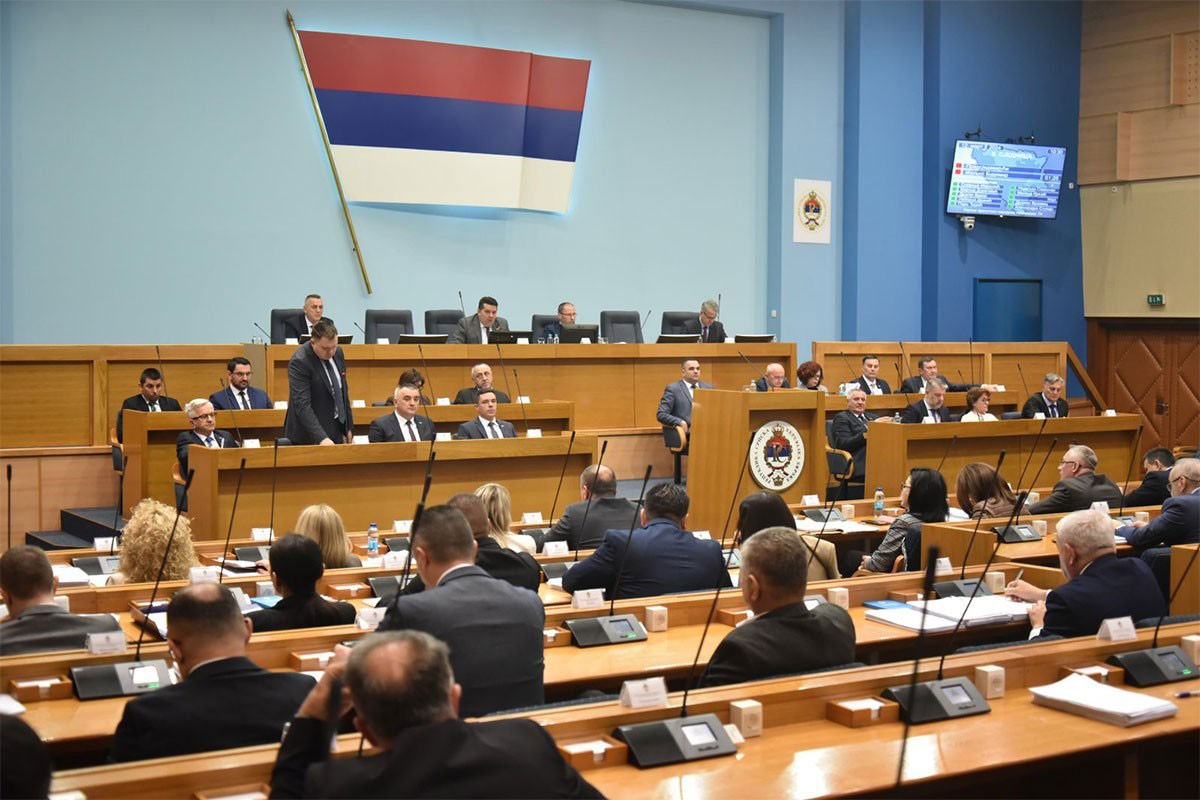

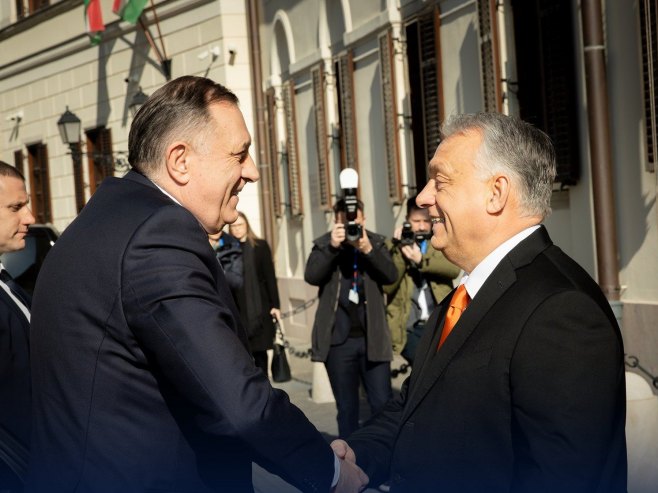


Visits by the Republika Srpska delegation first to Israel and then to the United States confirm the growing international status of Republika Srpska. The treatment it received in Jerusalem and Washington clearly shows that it is becoming a recognized geopolitical factor, reducing the room for maneuver of those who have so far sought to challenge its identity and its struggle for freedom.
This was stated for Glas Srpske by diplomat Zoran Milivojević, commenting on the international tour undertaken by the high-level delegation of Republika Srpska over the past few days.
“The treatment this delegation received in Israel deserves attention, just as it does in the United States, where a meeting was even arranged with Defense Secretary Pete Hegseth. This is confirmation of the identity and sovereignty of Republika Srpska, its international position in new geopolitical circumstances, as well as of the policy pursued so far. It is confirmation of its struggle for identity and the position of the Serb people not only in Republika Srpska, but throughout the entire region. These meetings also show that a certain stigma has been lifted from Republika Srpska as an entity and a factor, as well as from the Serb people. This is very important, especially if we know that the West has so far been the creator of political developments both in Bosnia and Herzegovina and in the Balkans. The change in the U.S. stance is of capital importance for the affirmation of the Serb question in the Balkans. Of course, this is also a kind of slap to all those who have so far tried to call into question the credibility and sovereignty of Republika Srpska and the Dayton Peace Agreement. I believe that all of this reduces the space for Christian Schmidt to continue behaving as he has until now,” Milivojević said.
Result
Diplomat Vladislav Jovanović says that this visit is undoubtedly the result of improved relations with the United States, but also of the increased reputation that Republika Srpska enjoys on the global stage.
“This, for some dramatic, improvement in relations with America will certainly limit the possibilities of those who have so far exerted enormous pressure on Republika Srpska. From Schmidt, through the Constitutional Court of Bosnia and Herzegovina, to certain Western European centers of power. This will also give the authorities in Banja Luka more room for maneuver, which is then an opportunity for Republika Srpska to position itself far better in this new redistribution of influence. By expanding and strengthening relations with countries that shape global politics, Republika Srpska can not only preserve its sovereignty, but further strengthen it. Sarajevo, that is, Bosniak political elites, should understand these changes in the world and stop their previous attacks, because continuing their current policy can only be counterproductive for them,” Jovanović told Glas Srpske.
The multi-day visit of the Republika Srpska delegation to Washington was marked by intensive and, as assessed, substantive talks with senior U.S. officials and members of Congress, accompanied by clear messages that the international position of Republika Srpska is changing. For the first time after a long period, it is no longer being discussed as a problem, but is being engaged as a credible and equal partner.
This is the general conclusion, and something also pointed out by Milorad Dodik during his stay in Washington, where he held a series of significant meetings which, according to diplomats and analysts, undoubtedly contributed to a better understanding of the position of Republika Srpska in international political circles.
Particular attention was drawn to the meeting with former U.S. National Security Advisor Michael Flynn, followed by a dinner organized by the retired general in honor of the Republika Srpska delegation at the Golden Institute. Numerous members of Congress attended the dinner, including Beth Van Duyne, Byron Donalds, Anna Paulina Luna, and other Republican congressmen.
Flynn believes that the Dayton Agreement was functional only at the moment the war ended, but that today it does not represent a sustainable framework for long-term stability in Bosnia and Herzegovina. According to him, post–Cold War arrangements are increasingly becoming a source of instability because they do not reflect changed power relations and new security realities. In this context, he views Bosnia and Herzegovina as a state trapped in the institutional architecture of the previous century, based on compromises from the 1990s rather than on the contemporary needs of society. Flynn particularly emphasized the importance of national sovereignty and the right of peoples to independently regulate their political systems, while protecting religious and identity rights.
Talks
During the National Prayer Breakfast, Dodik and the Republika Srpska delegation also met with Defense Secretary Pete Hegseth, with whom they discussed the importance of defending Christian values, principled politics, and the freedom of peoples as foundations for preserving dignity, sovereignty, and identity worldwide.
A meeting was also held with Speaker of the U.S. House of Representatives Mike Johnson. During this conversation, the importance of respecting the Dayton Peace Agreement, the constitutional competencies of Republika Srpska, and the principles of sovereignty was emphasized, as well as the responsibility of major powers in preserving stability at a time of numerous global challenges. On that occasion, Dodik stated that Republika Srpska does not seek more than what belongs to it, but will not accept less either.
During the multi-day visit, representatives of the Republika Srpska delegation also met with numerous members of Congress, including Blake Moore, Andy Ogles, Anna Paulina Luna, April Lynn McClain Delaney, as well as Senator Ron Johnson.
The talks addressed issues of preserving peace and stability, the constitutional competencies of Republika Srpska, the misuse of the judiciary for political purposes, as well as opportunities for strengthening economic cooperation and attracting investment.
From these meetings in Washington, the message was sent that Republika Srpska expects its voice to be heard without prejudice and narratives that have been created for years in the international public, and that it remains firmly committed to cooperation based on principles, respect for Dayton, and respect for the democratically expressed will of the people.
The Serb member of the Presidency of Bosnia and Herzegovina, Željka Cvijanović, was also one of the participants at the “Balkans Forward Summit.” She assessed that the new approach of the U.S. administration toward Bosnia and Herzegovina represents an encouraging shift toward a more balanced relationship with all its parts.
She emphasized that Republika Srpska consistently advocates a democratic political life in which decisions are made within domestic institutions, without foreign imposition. She also noted a visible shift toward an economic approach in U.S.–Bosnia and Herzegovina relations. Republika Srpska, she stressed, sees a particular opportunity in attracting U.S. investments, primarily in the fields of energy and infrastructure.
Mitrović: a good strategy
Professor at the Faculty of Political Sciences in Belgrade, Dragana Mitrović, says that this visit to Washington showed that the strategic choice, as well as the tactics chosen by Republika Srpska, were clearly very effective and successful. She believes that Milorad Dodik and the Serb member of the Presidency of Bosnia and Herzegovina, Željka Cvijanović, certainly had the opportunity to present the real state of affairs, warn about pressure on democratic processes in Republika Srpska, and point to the interests of the Serb people that are under threat.
She also believes that the Republika Srpska delegation had the opportunity to highlight pressure on Christian identity, an issue to which the U.S. administration is sensitive. Finally, she added that the meetings of Dodik and Cvijanović with numerous U.S. officials confirmed strong political connections and their ability to establish and maintain them.
In Washington, the Republika Srpska delegation met with White House press secretary Karoline Leavitt. Cvijanović also met with Senior Director for Counterterrorism at the U.S. National Security Council Dr. Sebastian Gorka and his associates, as well as with U.S. Deputy Secretary of State Christopher Landau.
Source: RTRS