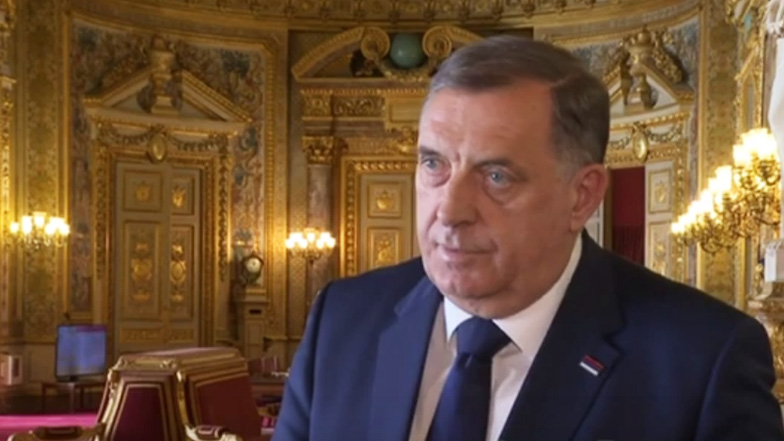



– Sometimes it is almost amusing, nearly caricatural, to read quasi-analyses and statements by various Federation and opposition politicians and media outlets who, for more than twenty years, have been predicting the “imminent end” of President Milorad Dodik’s political career, his “fall into isolation,” “loss of influence,” or “wrong policies.”
Every time they predict his political downfall, electoral reality disproves them, said political scientist and diplomat Marko Milisav to the Princip portal.
We are publishing his text in full:
That discrepancy between their wishes and the facts is the best proof of how deeply they underestimate a man who, whether one likes it or not, is one of the most experienced and skillful politicians and statesmen in this part of Europe. This is particularly true of Dodik’s foreign policy, which most directly reflects on internal political circumstances.
It is enough to list just a few of the decisions and policies that he and his associates have made and implemented over the past two decades to prove this.
At the height of liberal euphoria, at a moment when the entire region was chasing the illusion of rapid entry into globalist currents, Milorad Dodik chose a more difficult but more principled path—the path of sovereignism, traditional values, and the protection of national interests. What at the time seemed to many like an anachronistic approach is today increasingly considered the norm in a growing number of countries.
When Russia experienced the harshest diplomatic isolation in modern history, Dodik did not abandon relations with Vladimir Putin. Not because it was easy—quite the opposite, it was the hardest option—but because he understood deeper processes in international relations, the growing global clash of concepts, and the importance of stable alliances.
He showed the same kind of patience and political courage in his relationship with Viktor Orbán. While the Hungarian prime minister was portrayed in European media and by the Brussels establishment as the “black sheep of the EU,” Dodik recognized something that many noticed only later—that Orbán was building a long-term political model, that Hungary was strengthening its position, and that European trends would not remain forever as imagined by the liberal establishment. The victories of Robert Fico in Slovakia and Andrej Babiš in the Czech Republic further reinforced this approach.
At a time when politicians across Europe were waving Palestinian flags, often out of pure political conformism, Dodik advocated Israel’s right to self-defense, emphasizing legal principles rather than trends. It was not a popular position, but it was consistent and grounded.
A particularly significant aspect of Dodik’s political consistency is his relationship with the Republic of Serbia. Throughout his entire career, regardless of who was in power in Belgrade, Dodik cultivated stable, correct, and institutionally regulated relations with Serbia’s democratically elected leadership. He supported and sincerely welcomed every success and strengthening of Serbia, aware that a strong Serbia is the foundation of stability for the entire region and a key pillar for Republika Srpska. This policy of consistency came fully to the fore over the past decade in cooperation with President Aleksandar Vučić, with whom he built a relationship of mutual respect and political coordination, always insisting on peace, stability, and the preservation of shared national interests.
The clearest example of his political courage was his open support for Donald Trump at a moment when the entire Western media and NGO apparatus was demonizing the U.S. president on a daily basis. Dodik did not hesitate because he recognized that the world was entering a new phase, that U.S. foreign policy was changing, and that an era of realism was coming. Today, when many countries openly adopt policies advocated by Trump, it is clear that Dodik’s stance was strategic, not impulsive.
That is why it is wrong to label his moves as reckless or gambler-like. They may have appeared bold or out of step with the prevailing current at the time, but they were, as it turned out, always based on assessment, long-term analysis, and deliberate positioning.
Many see only the popular side of Milorad Dodik—the man who can sing at gatherings, who shares emotions with the people, and who is not ashamed to be who he is. What is often overlooked is that Dodik graduated from the Faculty of Political Sciences at the University of Belgrade at a time when that meant serious education and systematic political training.
It is also overlooked that Milorad Dodik is not only a participant but also a creator of contemporary Serbian history. Behind him are years and decades in which he led Republika Srpska through seemingly impossible conditions: he outlasted a series of high representatives, preserved the Republika Srpska police, protected its property, guided Srpska through floods, economic crises, sanctions, and political blockades—all without deviating from the fundamental goal of keeping the institutions of Republika Srpska intact, functional, and stable.
Looking back, every issue on which he was attacked—from relations with Russia, to Orbán, Israel, Serbia, Trump, and internal policies—ultimately showed that he was, without exception, right. Perhaps the greatest paradox is that those who have been predicting his political end for years fail to understand this: his political survival is neither accidental nor mere stubbornness. It is the result of strategic thinking, political experience, and a rare persistence to swim against the current when necessary.
That is precisely why, despite constant attacks, Milorad Dodik remains one of the few leaders in the region who has repeatedly demonstrated that he understands global trends better than many of those who critically analyze him. His political career is not the product of luck, but of vision, courage, and the ability to see, amid the greatest noise and dust, what others ignore. And for that reason, various Schmidts, Borenovićs, Konakovićs, and others will have to keep hoping—and waiting in vain—for the political end of Milorad Dodik.
Source: RTRS