



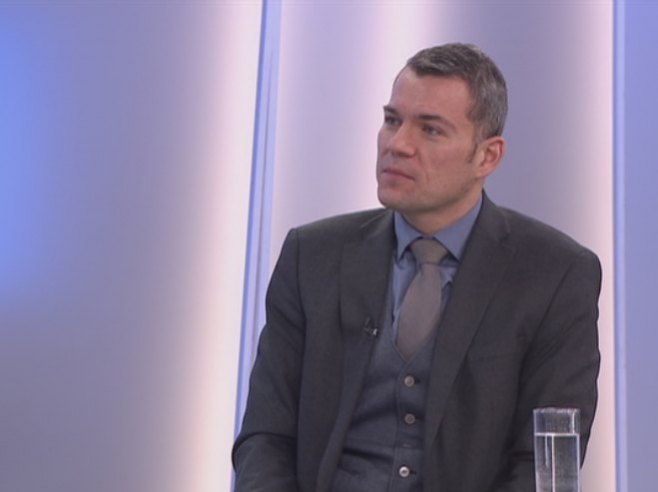
Igor Popović, a senior assistant at the Faculty of Law in Banja Luka specializing in international law, stated that proceedings against the president of SNSD and Republika Srpska leader Milorad Dodik before domestic courts would have to be repeated if the European Court of Human Rights in Strasbourg determines that one of the rights guaranteed by the European Convention on Human Rights has been violated.
Popović explained to RTRS that, in such a scenario, domestic judicial authorities would be obliged to reopen the proceedings and conduct them in line with the legal reasoning and findings of the Strasbourg court.
He stressed that the European Court cannot and will not assess whether domestic law was correctly applied in Dodik’s case, nor will it rule on the merits of the verdict itself. Instead, based on the evidence submitted by the defense, the Court may determine whether there has been a violation of fundamental rights and freedoms protected by the Convention.
Popović also clarified that the Court is not competent to assess the mandate or authority of the Office of the High Representative, which falls under the purview of the United Nations. According to him, the Strasbourg court generally defers to domestic authorities regarding law-making powers and focuses exclusively on potential human rights violations.
As Bosnia and Herzegovina is a member of the Council of Europe and a signatory to the European Convention on Human Rights, Popović noted that it is legally obliged to implement judgments of the European Court. He added that, in practice, Bosnia and Herzegovina usually complies with these rulings, with the notable exception of the Sejdić–Finci case, which he described as primarily political in nature.
Popović further explained that it is up to the defense, when filing an application with the European Court, to decide which Convention rights to invoke—such as the right to a fair trial or the principle of legality. Depending on the defense’s legal strategy and skill, other rights could also be raised, including freedom of thought, opinion, and expression.
Finally, he pointed out that proceedings before the European Court typically last several years once an application is declared admissible, assuming all formal requirements are met. However, the defense may request that the case be treated as a priority, as has been done in certain earlier cases.
Source: RTRS
 "“The Constitutional Court of Bosnia and Herzegovina now lacks Serb judges.")