

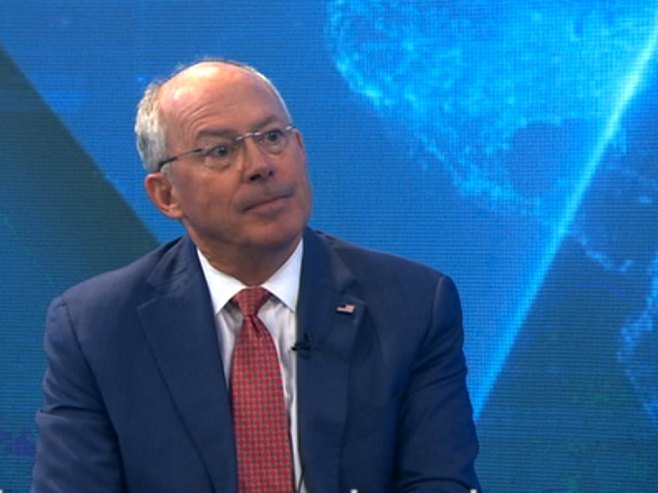
Joseph Schmitz, a former close adviser to U.S. President Donald Trump and an expert in constitutional law and sanctions, said in an interview with RTRS that Christian Schmidt and previous High Representatives in Bosnia and Herzegovina eroded the constitutional order by imposing and amending laws, because bureaucrats have no authority to change the Constitution.
Schmitz said that unelected bureaucrats cannot influence the will of the people or the people’s power to choose their president, comparing such attempts to what was tried in the United States.
“Unelected bureaucrats cannot interfere with the will of the people and the power of the people to choose their president, as was attempted in the United States. Brave people like U.S. President Donald Trump and SNSD leader Milorad Dodik must say, ‘This is not right, and we will not tolerate it,’” Schmitz said, adding that Trump and Dodik are true examples of sincere and strong leadership.
He stressed that when an unelected bureaucrat exercises powers that were never granted, this constitutes an abuse that should not be tolerated.
Schmitz also spoke about the “autopen” — a mechanical device used to replicate a signature — which was used by the administration of former U.S. President Joseph Biden. He explained that when someone without authority to exercise presidential power authorizes the use of an autopen, constitutional law defines such acts as void ab initio, without legal effect, as if they never existed.
“It is possible that a previous president actually authorized the use of his autopen. As part of the Oversight Project, we conducted extensive research and found very few such cases. There are very few clear instances where there is a documented trail showing that Biden made a decision and ordered his facsimile signature to be placed on a document. If such evidence does not exist, the presumption of regularity in government action no longer applies. I believe that such acts — whether sanctions, pardons, or any other measure — must be treated as null and void, as if they never existed,” Schmitz said.
He recalled that the Trump administration lifted sanctions against Dodik that had been imposed using an autopen, but noted that Dodik has been banned from political activity within Bosnia and Herzegovina.
“Where does that ban come from? Who directly or indirectly funded it with U.S. taxpayer money, and why has it not been lifted?” Schmitz asked.
He explained that every law must meet four essential criteria, and that the legal basis used against Dodik does not meet them.
“A law must be a rule, not a judgment; it must be of general significance and applicability, and it must be enacted by a sovereign authority. In the case of the ban on Dodik, this is not a rule, it has no general application, and it was not enacted by a sovereign. Constitutional theory holds that such laws are null and void. This is also contrary to Trump’s decision to lift sanctions against Dodik. I hope that my organization, the Oversight Project, will shed light on all aspects of how U.S. funds are being used to impose unlawful sanctions,” Schmitz said.
He emphasized that the Office of the High Representative was established by the Dayton Peace Agreement, but that “the powers exercised today either emerged informally or stem from the so-called Bonn process, not from a legitimate treaty.”
“At some point, the agreement itself may evolve into something else. If Bosnia and Herzegovina becomes a member of the EU, the question arises: do we still need a peace agreement, or should it be replaced by something else? There have been abuses, and we must examine the facts. If the facts turn out to be unpleasant and reach Trump, I assure you he will react,” Schmitz said.
He underlined that changing the Dayton Peace Agreement and the Constitution, as an integral part of it, without the consent of all signatories is unlawful.
“International treaties are foundational agreements between international parties. If, at some point, one party does not agree with how such a treaty or agreement is being implemented, that party may withdraw or terminate it. If that party is denied the right to self-determination and the agreement is violated, we arrive at the very situation that led to civil war. We call that slavery, and we have moved beyond it,” Schmitz said.
He added that abuse of powers granted by an agreement constitutes a breach of that agreement, and that the party harmed by such a breach has the right to terminate the agreement, seek damages, or pursue other legal remedies.
Source: RTRS