

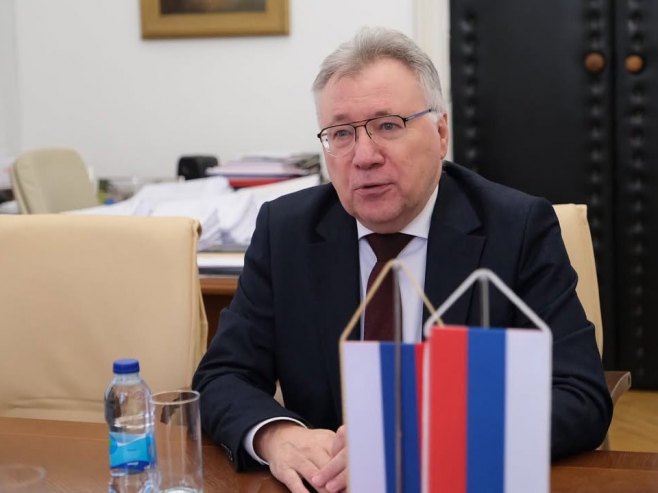
Western “partners” of Bosnia and Herzegovina are using all available means to implant the false idea among its leaders that energy cooperation with Russia is harmful, while seeking to subjugate the country in the same way they have done with Europe, said Russian Ambassador to Bosnia and Herzegovina Igor Kalabukhov.
In an op-ed for Glas Srpske, Kalabukhov noted that in recent months the term “diversification” has been increasingly used in Bosnia and Herzegovina, primarily in the context of ensuring the country’s energy security.
“The concept itself is not new and in theory implies certain benefits and advantages. However, in the case of Bosnia and Herzegovina, this economic phenomenon is fundamentally distorted by external forces and, in its new, deformed form, imposed as an unquestionable virtue,” Kalabukhov said.
In reality, he added, behind this appealing façade lies a rather trivial desire of certain international actors to achieve their own commercial interests at any cost and pursue specific political goals, which ultimately brings no real benefit to Bosnia and Herzegovina or its citizens.
He stressed that true diversification, capable of ensuring energy security, implies access to multiple sources of supply through independent routes.
“However, in the current reality, Bosnia and Herzegovina is simply being asked to blindly replace one supplier — which for years reliably provided the country with necessary energy — with another that seeks to monopolize the entire market and take control of national gas transportation infrastructure,” Kalabukhov said.
According to him, this resembles not diversification but the opposite process — unification, or reducing everything to a single denominator.
“In this case, it is the reorientation of Bosnia and Herzegovina, as well as other countries in the region, toward a source of supply that benefits exclusively Washington. As we say in Russia, using a common expression, the United States is forcing everyone into the same mold,” he added.
Kalabukhov expressed hope that decision-makers in Bosnia and Herzegovina would be guided by facts rather than opportunistic political interests when making decisions crucial to the country’s economic well-being.
He also emphasized that Russian companies, unlike their Western counterparts, have never shied away from fair competition or from creating conditions that genuinely ensure access to affordable and high-quality energy resources.
“Western ‘partners’ of Bosnia and Herzegovina are currently using all available means to instill a false belief that energy cooperation with Russia is harmful, demonizing not only Moscow’s policy but also real examples of successful cooperation that has lasted nearly half a century,” Kalabukhov said.
In their attempt to achieve absolute dominance over the region’s energy and economy, he added, they are effectively seeking to subjugate Bosnia and Herzegovina, just as they have done with Europe.
He pointed out that European institutions and research centers have already acknowledged that abandoning Russian energy resources led to the collapse of the EU’s economic strength, particularly affecting its most developed industrial sectors.
Citing Eurostat data, Kalabukhov noted that since the introduction of restrictions against Russia, the EU has overpaid approximately €200 billion for gas, while many experts estimate the real figure to be significantly higher.
The United States, he added, emerged as the main beneficiary by selling energy at inflated prices in the absence of fair competition, with European countries committing to purchase energy resources worth €645 billion from the US over the next three years.
“A similar scenario, involving brutal political pressure, is unfolding before our eyes in neighboring Serbia. This is yet another clear example showing that, in pursuit of absolute control over energy supplies in the region, Washington will not hesitate to destroy even a successfully functioning energy sector of a Balkan country,” Kalabukhov said.
He also noted that the price of gas supplied to Bosnia and Herzegovina by Gazprom, despite Western sanctions and pressure from certain local political actors, has remained affordable even during crisis years and continues to be the most competitive offer on the market.
Kalabukhov stressed that Russian companies remain open to cooperation with Bosnia and Herzegovina in the field of gasification, including not only the optimization and expansion of gas supply but also the development of transmission networks and construction of energy facilities.
He concluded by stating that for at least 15 years Bosnia and Herzegovina has been systematically pressured to abandon mutually beneficial cooperation with the Russian Federation, while the implementation of joint bilateral projects has been artificially blocked by certain countries openly lobbying for their own commercial interests.
Source: RTRS