


Over the past ten to fifteen years, the influence of the Muslim Brotherhood in Bosnia and Herzegovina has taken on a new, more institutionalized form.
Instead of the wartime structures of the 1990s, its former members, along with post-war theological cadres and sympathizers, now operate within political parties, religious institutions, non-governmental organizations, and academic communities. Together, they are building a network beneath the public radar, promoting political Islam as a desirable model for the state and social organization of Bosnia and Herzegovina.

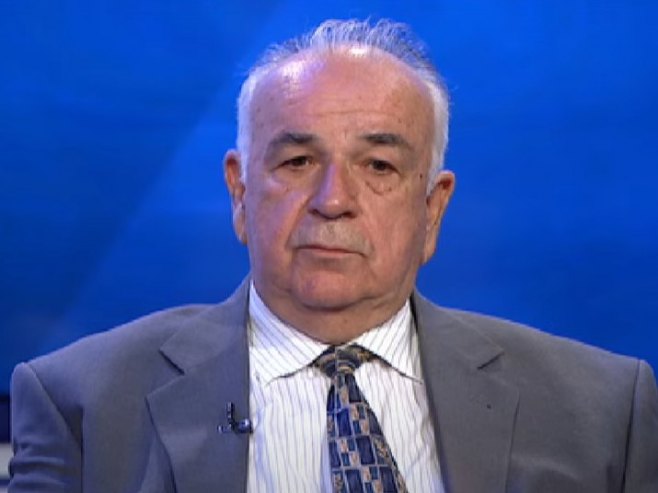
This was stated for Glas Srpske by Dušan Pavlović, director of the Center for Socio-Political Research of Republika Srpska, who noted that numerous reports by security services indicate the existence of a network connected to related structures in Western Europe—from Vienna and Berlin to Brussels—whose plans include turning Bosnia and Herzegovina, as European territory, into an Islamic state. According to Pavlović, these are organizations and ideological branches that are banned in certain countries and whose activities are closely monitored in the United States as well.
Dušan Pavlović
The global status of the Muslim Brotherhood further explains why its activities in Bosnia and Herzegovina are being monitored with increased attention. In several Middle Eastern countries—such as Egypt, Saudi Arabia, the UAE, Bahrain, Syria, and several Central Asian republics—the Brotherhood has been officially designated a terrorist organization. In Europe, Austria has gone the furthest by banning its organized activities, symbols, and infrastructure. Networks close to the Brotherhood are actively present in France, where security services have warned of deep infiltration into educational and religious institutions, while Sweden recently formed a special expert team to analyze its activities. The presence of branches and ideological groups linked to the Brotherhood has also been recorded in Germany, the United Kingdom, Belgium, and the Netherlands, where these networks are treated as a factor of political Islam with the potential for societal radicalization.
Continuity
Pavlović recalls that the administration of President Donald Trump recently initiated a process through which certain branches of the Muslim Brotherhood could be designated as foreign terrorist organizations and global terrorist groups. As stated in White House documents, the initiative is based on assessments by U.S. intelligence and security services and aims to limit transnational networks associated with militant and extremist structures and to prevent the spread of their influence.
Although the Muslim Brotherhood is not formally registered in Bosnia and Herzegovina, Pavlović emphasizes that there is a long historical continuity of its ideological presence to a greater or lesser extent, which he analyzed in detail last year. He notes that the roots go back to the 1970s, when the organization “Young Muslims” emerged in the then Socialist Republic of Bosnia and Herzegovina, led by Alija Izetbegović, the author of the “Islamic Declaration.” That document, he says, promoted political Islam, the concept of Islamic government, and the introduction of Sharia law as the basic legal framework. Particularly significant is the passage in which Izetbegović states: “We must therefore be preachers first, and then soldiers. Our weapons are personal example, the book, the word. When does force join this? The choice of this moment is always tangible and depends on a series of factors. However, there is a general rule: the Islamic movement should and can begin to take power as soon as it is morally and numerically strong enough not only to overthrow the existing non-Islamic government, but also to build a new Islamic one.”
This quotation precisely describes the ideological and strategic approach that is essentially identical to the doctrine of the Muslim Brotherhood and which has, over decades, been integrated into political activities in Bosnia and Herzegovina.
These ideas were revived in the 1990s with the founding of the SDA and the arrival of a large number of mujahideen from Islamic countries. According to Pavlović, the current influence of the Muslim Brotherhood in Bosnia and Herzegovina is visible in academic and religious structures that maintain ideological continuity by recycling theologians educated in Islamic countries, in political-cultural organizations that promote political Islam as a legitimate model of state organization, and in transnational ties with Turkey, Qatar, and other countries that today are the main patrons of ideologies close to the Brotherhood. According to him, the continuity of the Muslim Brotherhood reveals three key risks. The first is the growth of institutionalized ideological influence, as cadres linked to Brotherhood structures gradually enter educational, cultural, and religious positions of power. The second is transnational connectivity, since cooperation with networks in Turkey, Qatar, and Europe provides financial and organizational continuity. The third is a security risk arising from surviving wartime networks and ideological infrastructure that have in the past demonstrated the ability to recruit for international conflicts, such as the war in Syria.
“Although their presence in Bosnia and Herzegovina has for years been presented as ideologically benign or exclusively religious, practice has shown the opposite. The Muslim Brotherhood is by no means harmless. Its networks of contacts, activists, and ideological infrastructure have left a deep mark on institutions, political parties, religious structures, and security risks that still exist today,” Pavlović said.
Glas Srpske has received confirmation of Pavlović’s claims from sources close to intelligence services—that the ideas of the Muslim Brotherhood are still present in Bosnia and Herzegovina. According to these sources, the contemporary ideological framework of the Brotherhood is embraced by the SDA, the Islamic Community, and several non-governmental organizations close to these structures. They note that SDA leader Bakir Izetbegović was, in 2013, together with Yusuf al-Qaradawi, a longtime leader of the Muslim Brotherhood, a co-organizer of a conference of the European Council for Fatwa and Research—the Brotherhood’s umbrella organization in Europe. Several years later, Izetbegović helped organize a gathering in Sarajevo that brought together supporters and promoters of political Islam. Our sources state that former Bosnian foreign minister Bisera Turković met with Qaradawi in Qatar in 2019, and that her son Ali Turković, then a representative of the Intelligence-Security Agency (OBA) at the Embassy of Bosnia and Herzegovina in Doha, attended that meeting. There are also claims that Tarik Sadović, during his diplomatic service in Qatar, had numerous contacts with representatives of the Muslim Brotherhood.

Bisera Turković in the company of one of the leaders of the Muslim Brotherhood
Attention is also drawn to the role of Šemsudin Mehmedović, a former SDA official, who allegedly for years assisted members of the Muslim Brotherhood in Bosnia and Herzegovina, particularly former members of the “El Mujahid” unit, in covering up war crimes and resolving status issues.
Stronghold at the university
According to the same sources, the University of Sarajevo, under the influence of the Islamic Community, the SDA, and several NGOs, has become an important stronghold of ideas close to the Brotherhood. The role of professor Sakib Softić is mentioned, as well as the Gazi Husrev-beg Madrasa, whose long-time director was Mensur Malkić. The influence is also said to be felt within the Armed Forces of Bosnia and Herzegovina with logistical support from the organization “Bahar,” the Military Muftiate, and the Association of Generals of the Army of Bosnia and Herzegovina. There is reportedly a group of officers originating from the 7th Muslim Brigade, close to General Halil Brzina and the ideology of the Muslim Brotherhood.
Sources from Glas Srpske indicate that significant media space for Brotherhood ideas is provided by the newspaper Stav, whose editor-in-chief is Filip Mursel Begović, the portal Bosnia Times, controlled by Nedžad Latić, and Faktor, owned by the Turkish company Simurg Media. Similar editorial policies are pursued by the portals SAFF and BIR, under the control of the Islamic Community.
According to these sources, sympathizers and activists of the Muslim Brotherhood also operate within certain political parties in the Federation of Bosnia and Herzegovina—besides the SDA, also in the Democratic Front (DF) and parts of the Social Democratic Party (SDP). Among influential individuals mentioned are Halil Brzina, linked to the Turkish foundation “Hulusi Efendi,” former minister Bisera Turković, Nedžad Branković, Denis Zvizdić, Sheikh Halil Brzina, Šerif Patković, Salih Efendi Čolaković, former mufti Seid Efendi Smajkić, and others.
The sources state that Brotherhood strongholds also exist through educational institutions, religious centers, the NGO sector, and para-intelligence structures close to the SDA. Special mention is made of the activities of the “Alija Izetbegović” Foundation, managed by Hilmo Neimarlija, the Association for Culture, Education and Sport, the “Young Muslims” association led by Edhem Bokšić, the “Active Bosniak Network,” “Bahar,” businessman Mohamed Al Zayat, as well as several local associations that, according to available information, occasionally receive support from the Turkish development agency TIKA. Finally, they state that structures nurturing the ideas of the Muslim Brotherhood are strongest in Sarajevo, Zenica, Bihać, and Tuzla, but are also present in other cities of the Federation of Bosnia and Herzegovina.

Author of the “Islamic Declaration”: Alija Izetbegović
The presence of the Muslim Brotherhood in Bosnia and Herzegovina, Pavlović says, is no longer just a historical fact—it is a well-organized network that penetrates political parties, religious institutions, educational establishments, and non-governmental organizations. Although formally invisible, its influence is already shaping political and cultural currents within much of the Federation of Bosnia and Herzegovina, creating the potential for destabilization of the state.
Background
The Muslim Brotherhood was founded in 1928 in Egypt as a response to colonial domination and social crises in the Muslim world. However, during the 1970s and 1980s, parts of the Brotherhood radicalized. Certain branches began using militant methods, including terrorist actions, to achieve their political goals. This radicalization led to the organization being banned in several Arab countries, and its extremist branches becoming the focus of international security services, which later influenced the spread of its impact in Europe, including the Balkans.
Source: Glas Srpske