
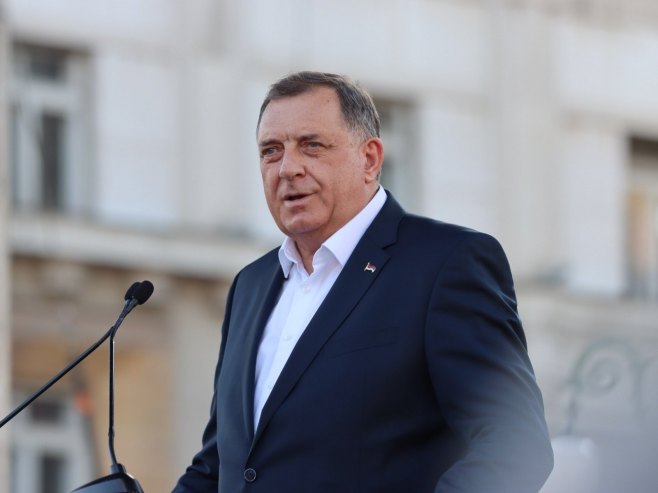
SNSD President Milorad Dodik stated that the deliberate obstruction of opening the newly built Gradiška border crossing is yet another proof that political Sarajevo systematically undermines the development of Republika Srpska, ignoring the needs not only of Srpska, but of all citizens and the economy of Bosnia and Herzegovina.
Dodik emphasized that citizens and businesses in Republika Srpska are hostages of political obstruction and the arbitrariness of Bosniak politics, which will lead BiH into a dead end. He said that this has been the reality for decades, and yet some object when he states that BiH is a failed experiment. If Sarajevo wants the BiH they constantly talk about, then they should be ready to discuss, reach agreements, and find solutions—rather than consistently pursuing policies of blockade, blackmail, and institutional pressure on Republika Srpska.
Asked to comment on the request of the Foreign Trade Chamber of BiH, which urged the competent institutions to open the Gradiška border crossing due to the economic losses caused by delays, Dodik stressed that Gradiška is fully prepared—both in terms of infrastructure and security—to operate as one of the most modern crossings in the region. However, Sarajevo lacks the political will to enable something that benefits everyone.
According to Dodik, any responsible political actor should work toward strengthening the economy and creating better living conditions for all residents of BiH—except, as he stated, for political Sarajevo, which tries in every possible way to block anything positive. Their goal, he added, is not a modern and prosperous, Dayton-based BiH, nor dialogue and cooperation, but a unitary state in which foreigners make decisions on their behalf.
He stressed that this blockade is not merely about the Gradiška crossing but a clear example of how Sarajevo envisions BiH: centralized, obstructed, and directed against Republika Srpska and the Serb people.
Dodik said that every good initiative from Banja Luka is treated as a threat rather than an opportunity and insisted that the people of Srpska must not—and will not—be hostages of Sarajevo’s political complexes and irresponsibility.
He emphasized that Republika Srpska’s institutions have both the right and obligation to demand the opening of the Gradiška crossing, as it concerns regional economic development, basic respect for the Dayton Agreement, and constitutional competencies.
Dodik pointed out that the blockade persists despite the fact that the bridge over the Sava River—linking BiH and Croatia—cost 19 million euros, paid equally by Croatia and BiH (that is, Republika Srpska), while the Federation of BiH invested nothing. He also noted that the Indirect Taxation Authority invested 24 million KM in building the new customs terminal.
He underscored that Sarajevo’s refusal to approve the opening of the Gradiška crossing is not technical but entirely political—a deliberate decision intended to punish Republika Srpska for refusing to be submissive. All other explanations, he said, are transparent excuses that directly harm businesses, transport, agriculture, and ordinary citizens who face hours-long delays at the border.
The newly built modern border crossing in Gradiška was constructed according to European standards. The customs terminal and crossing cover an area of 110,000 square meters and include central buildings for customs and border police, facilities for passenger and freight control, vehicle inspection, phytosanitary and veterinary inspection, customs offices, freight forwarding facilities, and control booths.
The terminal has 120 parking spaces for trucks, 100 for passenger vehicles, and a restaurant on-site.
The opening of the crossing between Croatia and BiH near Gradiška had been scheduled for December 11, but was postponed after Ziad Krnić, a member of the Board of Directors of the Indirect Taxation Authority, refused to support the necessary regulatory amendments for establishing the customs post and assigning customs officers.
Source: RTRS