

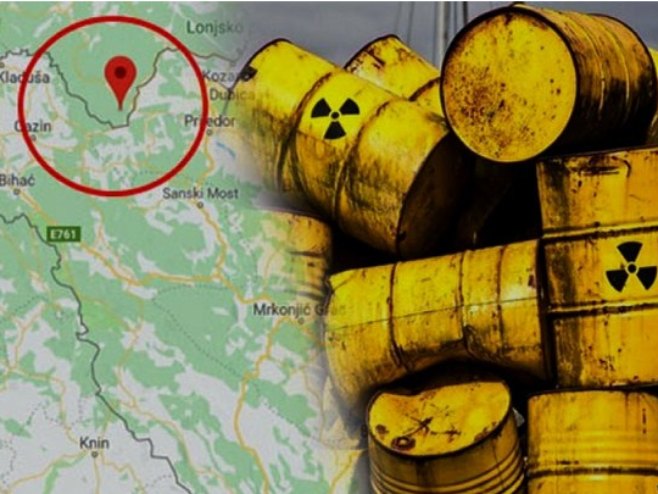
After last week’s debate, the Croatian Parliament adopted a law approving the construction of a radioactive waste storage facility on Trgovska Gora, only about 800 meters in a straight line from the border with Bosnia and Herzegovina.
Adopted without a previously approved environmental impact study and without proper cross-border consultations, the decision raises serious questions of safety, trust, and responsibility.
For Zagreb, it is a legal procedure. For the citizens of Republika Srpska and BiH, it is a message that decisions about their future are being made without them. The only remaining avenue is an appeal to international institutions.
The Una River basin is one of the most valuable natural resources in this part of Republika Srpska and BiH, with more than 200,000 people living in the surrounding region.
“Today’s move by the Croatian Parliament is nothing but a message to all of us living here in Novi Grad and this northwestern region that we might as well buy one-way tickets and leave for places where our neighbors will not endanger us,” said Mario Crnković of the Green Team Association.
Novi Grad mayor Miroslav Drljača stressed that the entire project represents an expression of hostility toward the residents of Novi Grad and BiH.
“We simply cannot tolerate such thinking from Croatia,” Drljača said.
The law was adopted despite the fact that no environmental impact study has been approved.
“That study should have been a mandatory step before adopting such a law, and it should have been followed by cross-border consultations,” emphasized Soja Kosanović of the Center for Environment in Banja Luka.
Environmental organizations in Croatia also criticize the decision, saying the location was chosen unilaterally and forcefully, without consultations with the local community or with BiH.
“We cannot believe claims that this will be the safest technology and solution. There is a major deficit of trust in the institutions. The question is what kind of oversight will be exercised there. We can only draw a parallel with what happened just days ago—when the country’s chief inspector was arrested,” said Luka Tomac of Green Action.
Authorities in Republika Srpska and BiH are announcing appeals to international bodies, including the Secretariat of the Espoo Convention on Transboundary Environmental Impact. A formal hearing with Croatia is scheduled for May next year.
“We are sending the final set of documents required for this process, along with the list of delegation members. This is one of the key steps ahead as we aim to prevent Croatia from proceeding, using the tools of law, expertise, and science,” said Bojan Vipotnik, Minister of Construction, Spatial Planning and Ecology of Republika Srpska.
Borislav Bojić, adviser at the Ministry of Foreign Trade and Economic Relations of BiH, stated that BiH has prepared a strong, high-quality response, drafted by expert and legal teams at the state level together with an international legal-expert consulting firm from Paris.
“I believe Croatia is not taking steps that would allow it to legally and legitimately build such a facility,” Bojić said.
Although the Croatian Parliament has adopted the law, the fight against the construction of the Trgovska Gora storage facility is entering a new phase.
On one side stands a legal decision; on the other, the deep concerns of citizens and experts — and the final outcome will likely be decided before international institutions.
Source: RTRS