


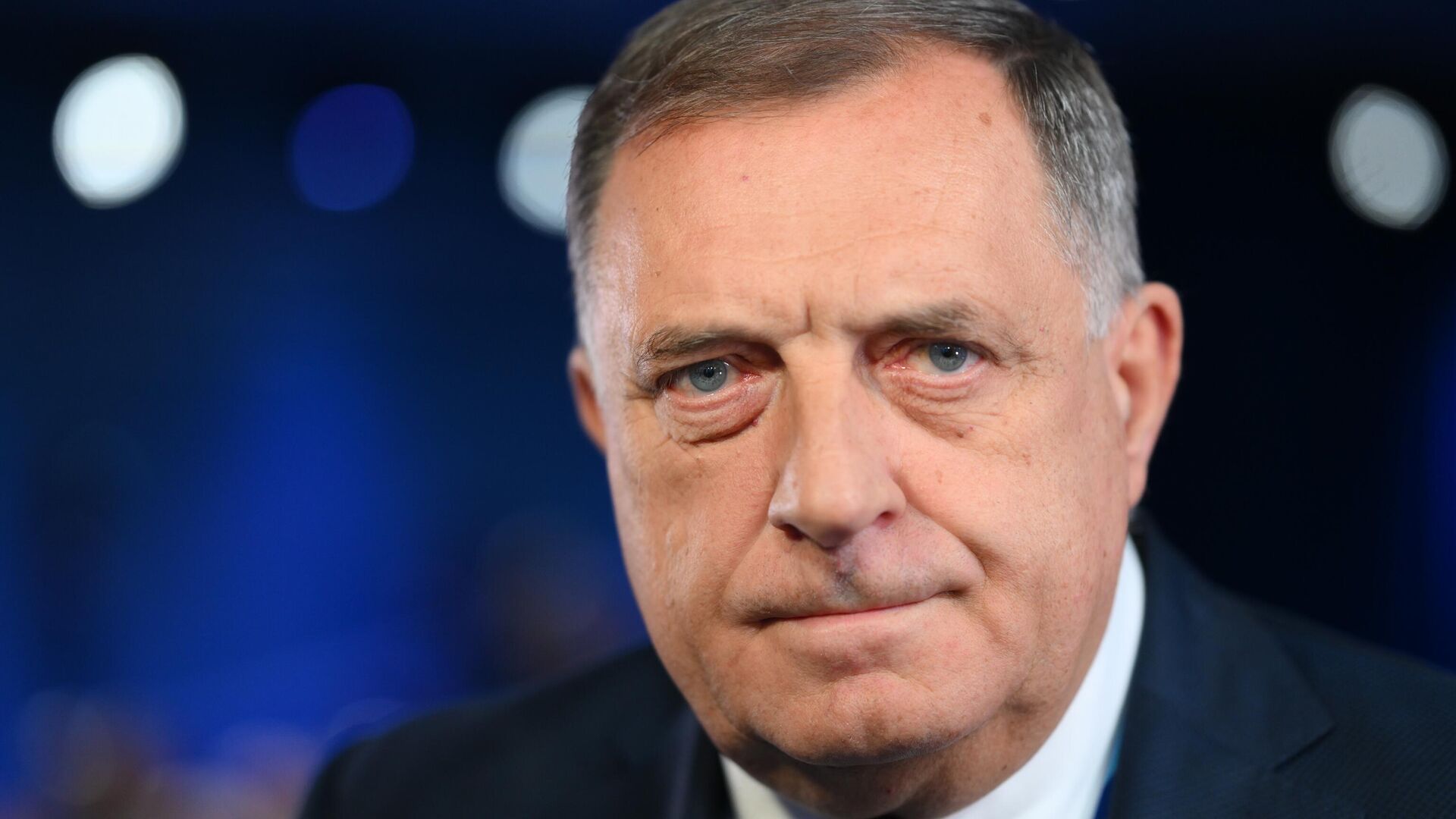
The Dayton Accords are not only a peace agreement — they established a constitutional and legal order and a complex internal structure that enabled Bosnia and Herzegovina to remain peaceful for three decades, despite challenges not created by Republika Srpska but by international actors, SNSD leader Milorad Dodik wrote.
In an op-ed for Politika, Dodik stated that peace in Bosnia and Herzegovina is not maintained through resolutions and pressure, but through respect for the Constitution of BiH, whose primary purpose was to end the war by establishing a constitutional framework.
According to him, any attempt to impose a unitary model on a country composed of three peoples and two entities is destined to fail because it disregards the fundamental basis of its existence.
Below is the full text of Milorad Dodik’s op-ed:
The truth is simple: whenever Bosnia and Herzegovina respected Dayton, it had peace. Whenever it violated Dayton, it entered a crisis. Thirty years after the signing of the Dayton Peace Agreement, the time has come to view this document once again without emotion, without ideological fog, and without political experiments that have eroded it for years.
Dayton is not only an agreement that ended the war; it created a constitutional and legal system — a complex internal structure that enabled Bosnia and Herzegovina to remain peaceful for three decades, despite challenges not created by Republika Srpska but primarily by international actors with shifting political agendas.
For Republika Srpska, the Dayton Agreement is an international treaty that confirmed the foundation of its political existence and guaranteed its competencies. This is not a matter of interpretation but the clearly written constitutional architecture: Republika Srpska holds all competencies except those explicitly transferred to the institutions of BiH under the Constitution.
Over the past 30 years, that constitutional provision has been systematically undermined through the seizure of competencies. High Representatives — signatories of Annex 10, who transformed themselves into a kind of foreign “gauleiter”, an anti-Dayton hybrid structure — carried out political actions outside the framework of international law and without the consent of domestic institutions.
Instead of safeguarding the agreement, they created a parallel system of governance that weakened the fragile balance instead of strengthening it. That is why it must be said clearly today: the biggest problem in Bosnia and Herzegovina is not the entities, but those who believe they can place themselves above the Constitution and international law — and especially those who accept such behavior.
Despite all this, Republika Srpska has remained faithful to the real Dayton — the one signed in 1995, not the versions retroactively rewritten. Bosnia and Herzegovina’s stability and even its survival depend on that consistency, regardless of criticism from certain political circles. Not because this is the will of one political actor, but because this is the only framework that reflects political reality and the equality of peoples. And the political reality is straightforward: without Serb consent, there is no decision in Bosnia and Herzegovina. This is not a threat — it is a Dayton fact.
Thirty years later, it is clear that Bosnia and Herzegovina functions only when the original Dayton is respected. When institutions are built on the agreement, not on imposed solutions. When the entities are respected, not bypassed. When decisions are made through consensus, not outvoting.
Bosnia and Herzegovina does not fail because it is complex — it fails because some persist in trying to make it unworkable.
Stability in Bosnia and Herzegovina has never resulted from centralization, as is often wrongly claimed, but from balance. Inequality in decision-making has not created a more efficient state — it has only deepened mistrust.
Any insistence on a unitary model in a country composed of three peoples and two entities is doomed to fail, because it ignores the essence of its existence. Dayton works when everyone respects it, and becomes problematic only when someone attempts to “improve” it.
Long-term stability can come only from returning to the principles of the original Dayton Agreement: equality, consensus, and clear respect for constitutional competencies. This means recognizing that the entities — and especially Republika Srpska — are pillars of the constitutional system, not obstacles to progress.
Politically, this also means dialogue — but a dialogue in which decisions are made not because embassies expect them, but because they reflect our own needs. A country that waits for instructions from abroad is not a country — it is an administrative zone.
Over the past three decades, Republika Srpska has shown that it is a politically mature community capable of preserving peace and developing institutions. It is not a destabilizing factor, but a guarantor of stability — precisely because it insists on what was actually signed, not on what was later attempted to be imposed.
As debates about the future of Bosnia and Herzegovina resurface, it is time for this fact to be acknowledged both in Sarajevo and in international circles.
Republika Srpska is not the problem in Bosnia and Herzegovina — Republika Srpska is the reason the country has not had another war in thirty years.
The Dayton Agreement ended the war and established the framework for political peace. Its strength lies in balance, not force. In agreement, not pressure. In respecting reality, not trying to replace it with bureaucratic wishes of declining power centers.
Peace in Bosnia and Herzegovina is not preserved through resolutions and pressure but through respect for the Constitution, which established the constitutional order as the mechanism to end the war.
This is why marking 30 years of Dayton is not only a remembrance of the day the war ended, but a reminder that peace lasts only as long as the agreement that created it is respected.
Republika Srpska remains committed to that agreement — because not only its own position, but the future of Bosnia and Herzegovina, depends on respecting the foundations rather than dismantling them.
Dayton is the only reason Bosnia and Herzegovina still exists, and for Republika Srpska it is far more than a legal framework — it affirmed the Republic as a place of peace and stability for the Serb people, built through their greatest sacrifices during the defensive-homeland war.
For some in Bosnia and Herzegovina, however, this same agreement is a “straitjacket”, which only shows that their concern is not for Bosnia and Herzegovina, but for expressing hostility toward Republika Srpska and the Serb people. Because of such impulses, Republika Srpska must always remain vigilant and steadfast in defending itself and its place within the order created by Dayton.
The narrative claiming that Bosnia and Herzegovina’s “European path” requires centralization is both false and anti-Dayton — and fundamentally anti-European. It is now clearer than ever, as the EU faces a deep systemic crisis, weakened as a community, lacking leadership, ideology, and perspective, socially fractured due to migration, turning toward militarization and new conflicts, with collapsing values and a declining economy.
The EU no longer offers anything except instability, uncertainty, and unpredictability. To surrender sovereignty for their distant goals is a refuge only for the naive.
Serbia, as a signatory and guarantor of the Dayton Peace Agreement, has consistently supported its full implementation for thirty years. Every step taken by Serbia has aimed at stabilizing relations, rebuilding trust, and fostering regional cooperation. Europe showed its hypocrisy by excluding Serbia from the Peace Implementation Council — an informal body whose purpose is unclear in the first place.
The Russian Federation the original Dayton Agreement, and because of that, it has faced pressure from what was once called the “collective West.” Russia has never acted to benefit one side in Bosnia and Herzegovina at the expense of the other, and its positions reflect the actual letter of Dayton.
Under President Donald Trump, the United States demonstrated a policy of peace and cooperation — acknowledging the interests of others. Trump’s statements that America will not build other nations (which we read as Bosnia and Herzegovina), will not create artificial national identities (we read: a Bosnian nation), and will not intervene in the internal affairs of other countries (we read: Bosnia and Herzegovina), represent an affirmation of the true principles of Dayton.
Recent provisions of the U.S. National Security Strategy confirm this — recognizing the rights of peoples (including the Serb people) to decide on their interests equally with others. For us, this signals light at the end of the long political tunnel of the Clinton, Obama, and especially Biden eras.
Source: RTRS